

 English
 русский
 عربى
 中文简体

Content
- 1 Why Grade 316 Earns Its Place in Demanding Service
- 2 What a 316 Stainless Steel Pipe Fittings Factory Should Offer
- 3 Inside the Plant: From Coil to Finished Fitting
- 4 Non-Standard Work: Where a Factory Adds Real Value
- 5 A Practical Checklist Before You Place the Order
- 6 How an Order Usually Runs
- 7 Questions Buyers Ask Most Often
Choosing grade 316 for pipe fittings is usually the easy part. Making sure the fittings that arrive on site actually behave like 316, in the bore, at the weld preparation and through the heat-affected zone, is where a factory either earns repeat orders or quietly loses them. Molybdenum does the heavy lifting in this grade, and it does not forgive shortcuts in melting, forming or heat treatment.
What follows is a practical look at how buyers evaluate a 316 stainless steel pipe fittings factory: material provenance, dimensional control, welding and machining capability, documentation, and the logistics of getting the right parts to site on schedule. It is written from the perspective of a supplier that holds the raw material and builds the finished component in the same plant, because that is the combination most industrial projects end up depending on.
Why Grade 316 Earns Its Place in Demanding Service
Grade 316 adds roughly 2 to 3 percent molybdenum to the austenitic structure. That single alloying element lifts the pitting resistance equivalent number from around 18 in 304 to somewhere near 25. In practice, fittings stay sound in chloride-bearing water, salt-laden air, many organic acids and a long list of process streams where 304 would begin to pit within a few months of commissioning.
The L version takes carbon down to 0.03 percent or below, which matters most on welded fittings. A standard 316 elbow that sees a lot of arc time near the seam can form chromium carbides at the grain boundaries, and those chromium-depleted zones become the first place corrosion starts. Ordering 316L, backed by an intergranular corrosion test when the specification calls for one, removes that risk without a full post-weld solution anneal. Temperature behaviour is worth noting as well: 316 keeps useful strength and oxidation resistance well past the range of general-purpose 300-series grades, although continuous duty above roughly 800 degrees Celsius is normally a conversation about more specialised alloys.
- Chemical and petrochemical process lines handling acids, solvents and chloride streams.
- Marine and offshore piping, deck drainage, ballast and washdown systems.
- Food, dairy and pharmaceutical circuits that need hygienic, cleanable surfaces.
- Water treatment, desalination and high-chloride cooling water.
- Pulp and paper bleach plants, where chloride and oxidising chemicals combine.
What a 316 Stainless Steel Pipe Fittings Factory Should Offer
Range, Standards and Construction
Range matters less for its own sake than for how much of a project can be sourced from one qualified supplier. A capable factory covers 45, 90 and 180 degree elbows, equal and reducing tees, concentric and eccentric reducers, caps, stub ends and flanges, in both seamless and welded construction, typically from half an inch to 24 inches and beyond, with wall schedules from SCH10 through XXS. Common reference standards include ASME B16.9 and B16.5, EN 10253, DIN 2605, JIS B2311 and GOST 17375, while the material marks most often quoted are WP316 and WP316L under ASTM A403, and 1.4401 and 1.4404 under the European system.
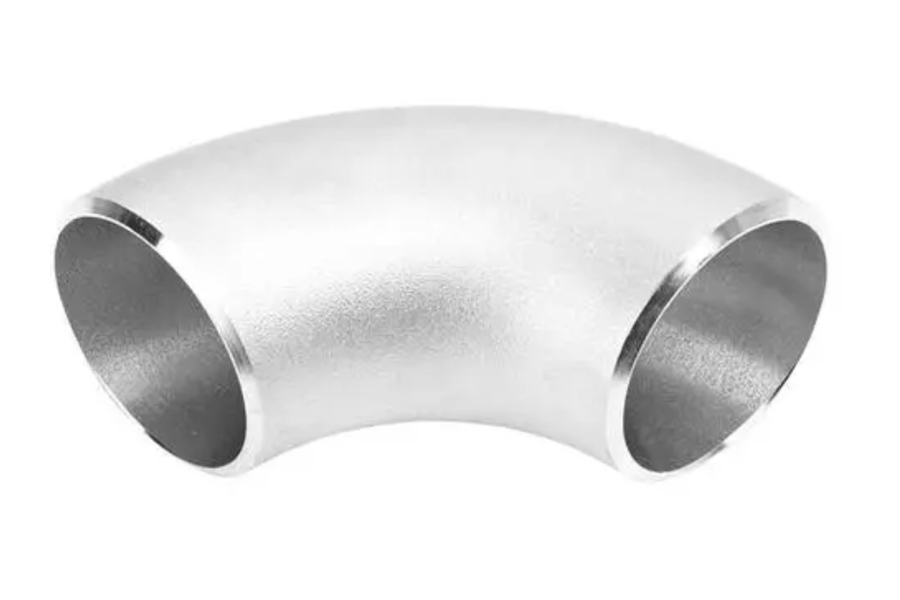 Stainless Steel Pipe Fittings for Piping SystemsCovers tees, flanges, reducers, elbows and caps in 304/304L/316/316L stainless steel, with custom dimensions and pre-delivery inspection for varied piping projects.View Product →
Traceability, Testing and Documentation
Paperwork is where a cheap quotation usually shows its true cost. Buyers should expect inspection documents that link every fitting back to a specific heat, and test records that can be checked against the purchase order rather than taken on trust. A typical package includes mill certificates to EN 10204 3.1, positive material identification on each heat, dimensional and wall thickness checks, hardness survey, radiography or dye penetrant inspection of welds where specified, hydrostatic testing, and confirmation of pickling and passivation on the finished surface. Packing marks, heat numbers and standard references should be legible on the fitting itself, not only on the box.
| Grade | Molybdenum | Maximum carbon | Best suited to | Fabrication note |
|---|---|---|---|---|
| 304 / 304L | None | 0.08 / 0.03 percent | General service, food, architectural work | Lowest cost; pitting risk in chlorides |
| 316 | 2 to 3 percent | 0.08 percent | Chemical, marine, pulp and water lines | Broad corrosion resistance at moderate cost |
| 316L | 2 to 3 percent | 0.03 percent | Welded assemblies, pharma and food circuits | Resists sensitisation without post-weld anneal |
| 316Ti | 2 to 3 percent plus titanium | 0.08 percent | Elevated temperature, cyclic thermal duty | Stabilised against intergranular attack |
Inside the Plant: From Coil to Finished Fitting
Stock position is the quiet advantage in this business. A material warehouse holding around 20,000 tonnes of coil shortens the gap between order confirmation and first cut, and keeps grade substitution from creeping in when a mill lead time slips. The production route that follows is straightforward but unforgiving: cutting and slitting, forming or bending, welding and dressing, machining of faces and bores, heat treatment where the grade or the standard requires it, then pickling and passivation before final inspection. More detail on the process controls used at each step is available on our technology page.
Non-Standard Work: Where a Factory Adds Real Value
Catalogue fittings cover most of a line, but the awkward joints are usually the ones holding up commissioning: a bend that has to match an existing spool, a run that needs a heavier wall than the schedule allows for. Being able to bend, weld and machine to a drawing, rather than only shipping from a list, is often what separates a genuine manufacturer from a stockist.
Process equipment asks for more again. Jacketed flanges with a heating or cooling medium circulating behind the sealing face, half-pipe headers welded to vessel shells, large-caliber thick-walled welded pipe, plasma-welded pipe spools and one-off CNC parts all sit in the same production envelope as standard elbows and tees. Having the raw plate, pipe and forging stock in-house means these items are machined from known material rather than sourced and re-certified under time pressure.
A Practical Checklist Before You Place the Order
- Confirm the grade and carbon level: 316, 316L or a dual-certified material, and whether the end user specification demands a stabilised grade.
- Match the dimensional standard to the pipe you are actually joining, including bevel angle, root face and centre-to-face tolerances.
- State the pressure class and schedule, and check that the wall thickness at the weld prep is consistent with the mating pipe.
- Agree the testing plan in writing, including NDT coverage, hydrostatic pressure and any intergranular corrosion requirement.
- Review the welding procedure and welder qualification for welded fittings, particularly on thin-wall and large-diameter items.
- Confirm surface condition, marking method and packing, so that site storage does not undo the passivation work done in the plant.
How an Order Usually Runs
Most projects begin with a drawing, a data sheet or a bill of materials rather than a finished specification. Technical staff review the request, clarify the standard and grade, and quote against the actual delivery scope. First articles or sample fittings are common on new assemblies, and pre-shipment inspection can be witnessed by a third party if the buyer prefers. If you are at that stage now, sending your enquiry through our contact page is the quickest route to a technical response rather than a bare price list.
Questions Buyers Ask Most Often
Is 316L always better than 316?
For welded fittings and anything that will be fabricated on site, 316L is generally the safer choice because it resists sensitisation during welding. For seamless fittings in moderate service, standard 316 performs perfectly well and is sometimes the more economical answer.
Can fittings be supplied against a non-standard dimension?
Yes, provided the drawing is clear about the critical dimensions. Custom bends, special flanges and transitional pieces are routine work for a factory that already holds the parent material and the machining capacity.
What documents should arrive with the shipment?
At minimum, mill certificates with heat numbers traceable to each item, dimensional and test records, and a packing list that matches the marks on the fittings. Additional NDT or corrosion test reports should be listed in the purchase order so nothing is left to interpretation.
A 316 fitting is a small item in a large project, but it sits at the point where pressure, temperature and chemistry meet. Choosing a factory that can show where the steel came from, how it was formed and welded, and what was measured before dispatch is the most reliable way to keep those joints out of the maintenance budget for the next twenty years.