

 English
 русский
 عربى
 中文简体

Content
- 1 What the "316L" Designation Really Tells You
- 2 The Shapes You Will Meet Most Often
- 3 Matching the Connection to the Service
- 4 Standards and the Markings That Matter
- 5 Where 316L Fittings Earn Their Keep
- 6 Notes from the Shop Floor on Welding and Installation
- 7 What to Verify Before You Accept a Delivery
Ordering 316L stainless steel pipe fittings can look like a simple errand — until a welder calls about a cracked elbow, or a quality engineer asks why the heat number stamped on a fitting does not match the mill certificate. The grade itself is well understood; it is the details around it that decide whether a line runs quietly for twenty years or leaks in its first quarter.
We handle these fittings every day, alongside the matching pipe, flanges and welded components that go into the same systems. What follows is a practical walk-through: what 316L actually is, how the common fitting shapes differ, which connection method suits which service, and what is worth checking before you accept a delivery.
What the "316L" Designation Really Tells You
316L is the low-carbon member of the 316 family. Its chemistry sits at roughly 16–18% chromium, 10–14% nickel and 2–3% molybdenum, with carbon capped at 0.03% instead of the 0.08% allowed in standard 316. You will meet it as UNS S31603, EN 1.4404, or Grade 316L under ASTM A403 and A182.
The molybdenum is the part that buys extra corrosion resistance. It strengthens the passive film against chlorides and against reducing acids such as sulfuric and phosphoric solutions, which is why 316L appears so often in chemical and coastal service where a 304 fitting would pit. The low carbon is what makes the grade workable after welding. Heat ordinary 316 into the 450–850 °C window during welding and chromium carbides precipitate along the grain boundaries, leaving the neighbouring metal chromium-poor — the classic "weld decay". At 0.03% carbon there is simply not enough carbon left to form those carbides, so the heat-affected zone keeps its corrosion resistance without a post-weld solution anneal.
Annealed mechanicals for A403 WP316L are a minimum tensile strength of 485 MPa, yield of 170 MPa and elongation of 40%. That is softer and more ductile than the duplex grades — helpful during cold bending and field fit-up, less helpful where erosion or very high pressure calls for a harder material.
| Grade | Carbon (max) | Molybdenum | PREN (approx.) | Typical role |
|---|---|---|---|---|
| 304L | 0.03% | — | 18–20 | General water, food and mild atmospheric duty |
| 316L | 0.03% | 2.0–3.0% | 24–26 | Chlorides, reducing acids, marine and chemical lines |
| 316 | 0.08% | 2.0–3.0% | 24–26 | Unwelded parts and heavier sections |
| Super-austenitic grades | 0.02% | 4–7% | 30+ | Severe chloride and acid service beyond 316L |
The Shapes You Will Meet Most Often
Once fittings are stacked on a shelf they all start to look alike, so it helps to think in terms of what each shape does to the flow. Elbows turn the line — 45°, 90° or 180°, in long radius where pressure drop matters and short radius where space is tight. Tees split or merge flow, either equal or reducing. Concentric reducers change bore on a straight run, while eccentric reducers keep the bottom of the line flat so liquids drain and slurries do not settle. Caps close a run; stub ends pair with lap-joint flanges so the flange can be rotated during assembly; couplings and unions join small-bore pipe; crosses handle four-way intersections.
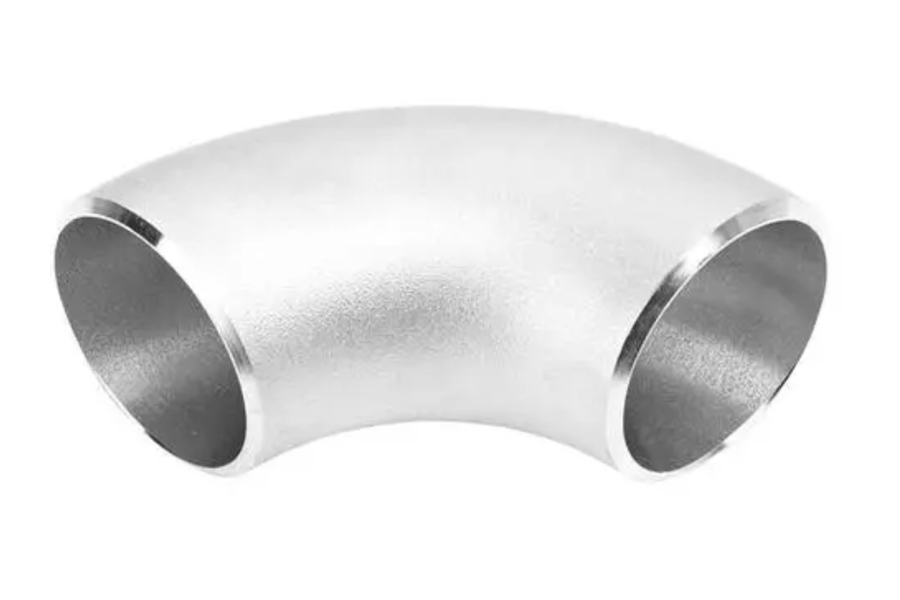 Stainless Steel Pipe Fittings by Shape and ConnectionBrowse stainless steel elbows, tees, reducers, caps and unions in 304/304L/316/316L, with guidance on seamless versus welded fittings.View Product →
One distinction worth watching is how the fitting is made. Seamless fittings (WP-S) are formed from seamless tube, while welded fittings (WP-W) carry a longitudinal seam. For most process duty the seam is perfectly acceptable, but in highly corrosive, cyclic or high-purity service it is one more feature to inspect, and some specifications rule it out entirely.
Matching the Connection to the Service
Butt-weld fittings to ASME B16.9 give a permanent, full-penetration joint with no crevice, which is why they dominate high-pressure and hygienic work. Socket-weld fittings (B16.11) are quicker to install in small bore but leave an internal gap that traps product — fine for utility air and water, questionable for corrosive or aseptic duty. Threaded fittings suit maintenance-heavy utility lines but thin the wall at the thread root and are best avoided in cyclic service. Hygienic clamp, SMS and DIN unions belong to dairy, beverage and pharmaceutical piping, where the joint must be cleaned in place.
Stainless Steel Pipe Elbows in 304, 304L and 316LChange pipeline direction with welded, stamped, cast, forged or clip elbows in 304/304L/316L, available with mirror, matte or sandblasted finishes.View Product →Standards and the Markings That Matter
Most buyers work to ASTM A403 for wrought fittings and A182 for forged flanges, with dimensional standards following ASME B16.9 for butt weld, B16.11 for socket weld and threaded, and B16.28 for short-radius elbows; European projects tend to cite EN 10253 or DIN 2605. A properly marked fitting carries the grade, heat number, size, wall schedule, standard and manufacturer. That heat number is the thread you pull when you need to trace a problem back to a melt.
For welded systems, the pipe behind the fitting deserves the same attention — a mismatched schedule or grade creates a crevice or a galvanic couple that no fitting quality can rescue. Our notes on pipe connection solutions cover a few of these pairings in more detail.
Where 316L Fittings Earn Their Keep
Chemical and petrochemical plants use 316L for lines carrying organic acids, solvents and moderately aggressive process streams. Pharmaceutical and food producers value the cleanability of a fully welded 316L run. Desalination and marine work leans on the molybdenum for pitting resistance in warm chloride environments, while water treatment and pulp lines pick it up where 304 has historically failed too early. Flanged connections tie these systems into vessels, pumps and headers, and the flange grade, facing and pressure class must track the line rather than be chosen on price alone.
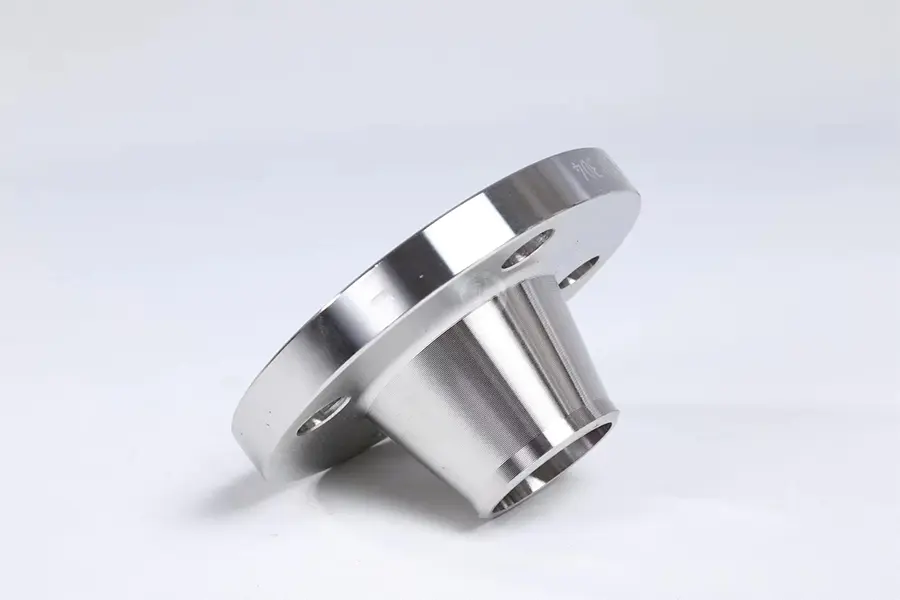 Stainless Steel Flanges for Piping and Equipment ConnectionsConnect lines to vessels, pumps and headers with flanges in 201, 304/304L, 316L, 321, 310S and 347, including flat-welded and butt-welded types.View Product →
Notes from the Shop Floor on Welding and Installation
- Use an ER316L filler and keep heat input modest; a controlled interpass temperature protects the passive film on both sides of the joint.
- Purge the inside of the line with argon on sanitary and chemical work. Sugaring on the root is a corrosion site that no amount of external polishing will fix.
- Keep carbon steel tooling away from the stainless. Grinding dust and steel brushes embed free iron, and the rust spots that follow are often blamed on the material.
- Clean and passivate after welding, particularly on the heat tint, which is chemically different from the parent metal.
- Check alignment before tacking. A long-radius elbow forced into position stores stress that shows up later as a cracked weld.
What to Verify Before You Accept a Delivery
- Certificate EN 10204 3.1 with heat numbers matching the stampings on every fitting.
- Positive material identification on a sample, especially when 316L and 316 arrive on the same pallet.
- Wall thickness and centre-to-face dimensions against the purchase standard, not just the label.
- Surface condition: no laps, roll marks or weld spatter, and no iron contamination.
- Hardness within the annealed limits, plus an intergranular corrosion test if the service demands it.
None of this is exotic. It is the ordinary discipline that separates a system that ages gracefully from one that keeps a maintenance team busy. If you are still weighing up grades, schedules or connection methods for a particular line, tell us what the pipe is carrying and at what temperature — that conversation usually settles the specification faster than any catalogue. You can reach our team through the contact page, and we will gladly talk through the details before you place an order.