

 English
 русский
 عربى
عربى 中文简体
中文简体
Content
- 1 What Makes Stainless Steel Pipes Different from Other Metal Pipes
- 2 Common Stainless Steel Grades Used in Pipe Manufacturing
- 3 Seamless vs. Welded Stainless Steel Pipes
- 4 Key Dimensions and Specifications to Understand
- 5 Surface Finishes and Their Practical Significance
- 6 Industry-Specific Applications of Stainless Steel Pipes
- 7 Practical Tips for Buying and Specifying Stainless Steel Pipes
Stainless steel pipes are among the most widely used fluid and gas conveyance materials across industrial, commercial, and residential applications worldwide. Their combination of corrosion resistance, mechanical strength, hygienic surface properties, and long service life makes them a preferred choice in industries ranging from oil and gas to food processing, pharmaceuticals, construction, and water treatment. However, stainless steel pipe is not a single product — it encompasses a broad family of grades, manufacturing methods, sizes, and surface finishes, each optimized for specific conditions and applications. Understanding these distinctions is essential for making the right selection the first time and avoiding costly failures, replacements, or compliance issues down the line.
What Makes Stainless Steel Pipes Different from Other Metal Pipes
Stainless steel derives its corrosion resistance from the addition of chromium — at least 10.5% by mass — to the iron and carbon base of conventional steel. This chromium content reacts with oxygen in the environment to form a thin, stable, self-repairing passive oxide layer on the metal surface. This passive layer is what prevents the underlying metal from reacting with moisture, chemicals, and atmospheric oxygen — the main causes of rust and degradation in standard carbon steel pipes.
Beyond corrosion resistance, stainless steel pipes offer a set of performance advantages that make them superior to alternatives such as carbon steel, copper, galvanized steel, and plastic in demanding environments. They maintain structural integrity across a wide temperature range, from cryogenic conditions to sustained high-temperature service above 800°C in certain grades. They are non-porous and easy to clean, which is critical in hygienic applications. They also offer excellent tensile strength, allowing for thinner wall thicknesses compared to carbon steel while maintaining equivalent pressure ratings — reducing weight and material cost in large-scale installations.
Common Stainless Steel Grades Used in Pipe Manufacturing
The grade of stainless steel used in pipe production determines its corrosion resistance, mechanical properties, weldability, and suitability for specific media and temperature ranges. Selecting the wrong grade is one of the most common and costly mistakes in pipe system design.
| Grade | Type | Key Properties | Typical Applications |
| 304 | Austenitic | Good corrosion resistance, excellent weldability | Food processing, water systems, general industrial |
| 316 | Austenitic | Superior chloride resistance due to molybdenum content | Marine, chemical processing, pharmaceuticals |
| 316L | Austenitic | Low carbon for improved weld zone corrosion resistance | Heavy welding applications, medical equipment |
| 321 | Austenitic | Titanium-stabilized for high-temperature service | Exhaust systems, aircraft, high-temp industrial |
| 2205 | Duplex | Very high strength and stress corrosion cracking resistance | Oil and gas, desalination, chemical plants |
| 410 | Martensitic | High hardness and wear resistance, moderate corrosion resistance | Pump shafts, valve components, cutlery industry |
Grade 304 and 316 account for the vast majority of stainless steel pipe applications globally. Grade 304 is sufficient for most general-purpose and food-contact applications, while 316 and 316L are required when chloride exposure — from seawater, cleaning chemicals, or saline process fluids — presents a risk of pitting corrosion. Duplex grades like 2205 are specified for high-pressure, high-corrosion environments where both strength and chemical resistance are simultaneously critical.
Seamless vs. Welded Stainless Steel Pipes
One of the most fundamental distinctions in stainless steel pipe selection is the manufacturing method: seamless or welded. Both produce pipes that meet rigorous industry standards, but they differ significantly in performance characteristics, cost, and appropriate applications.
Seamless Stainless Steel Pipes
Seamless pipes are manufactured by extruding or piercing a solid stainless steel billet — a process that forms the pipe without any longitudinal seam or weld joint. The result is a pipe with uniform wall thickness, consistent grain structure throughout the cross-section, and no weld zone to act as a potential weak point or corrosion initiation site. Seamless pipes are the preferred choice for high-pressure applications, fluctuating pressure environments, and systems carrying aggressive chemicals or gases. They are specified in oil and gas upstream operations, power generation boiler tubes, hydraulic systems, and any application where weld integrity under cyclic stress cannot be fully guaranteed.
Welded Stainless Steel Pipes
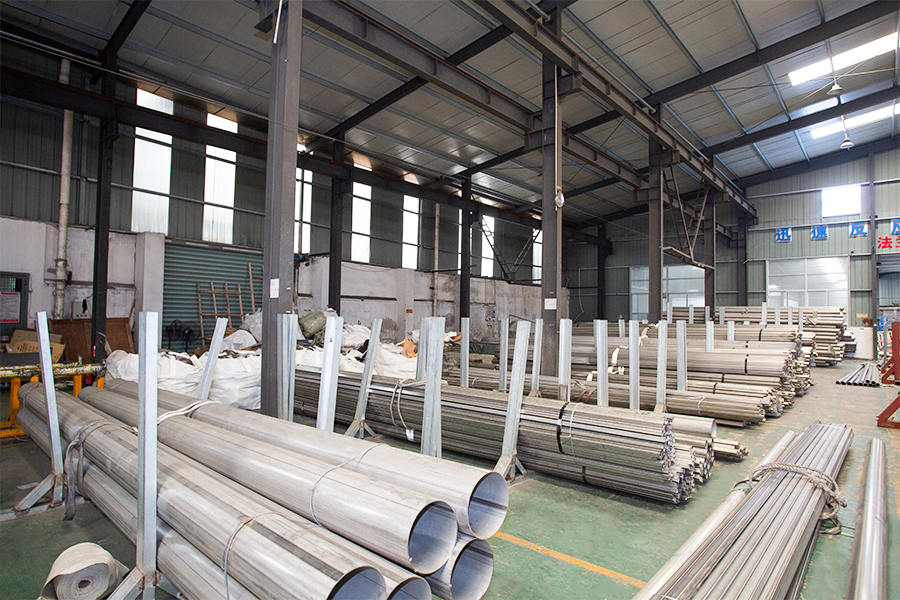
Welded pipes are formed by rolling flat stainless steel strip or plate into a tubular shape and then joining the longitudinal edges by welding — typically using TIG (tungsten inert gas) or laser welding for stainless grades. The weld seam is then annealed and often cold-worked to normalize its microstructure and bring its properties as close as possible to the parent material. Welded stainless steel pipes are more economical than seamless equivalents, available in larger diameters, and entirely adequate for the vast majority of commercial and industrial applications — including water distribution, HVAC systems, food and beverage processing lines, and structural tubing. Modern welding technology has dramatically closed the performance gap between welded and seamless pipe in moderate-pressure service conditions.
Key Dimensions and Specifications to Understand
Stainless steel pipes are specified using a standardized system of nominal pipe size (NPS) or outside diameter (OD) combined with a schedule number that indicates wall thickness. Understanding this system is essential for ordering correctly and ensuring compatibility with fittings, flanges, and other system components.
- Nominal Pipe Size (NPS): A dimensionless designator that approximates the pipe's inside diameter in inches for sizes up to 12 inches. Above 14 inches NPS, the designator equals the actual outside diameter.
- Schedule Number: Determines wall thickness. Common schedules for stainless steel include Schedule 5S, 10S, 40S, and 80S. Higher schedule numbers indicate thicker walls and higher pressure ratings. The "S" suffix denotes stainless steel schedules, which differ from carbon steel schedule dimensions.
- Outside Diameter (OD): Remains constant across all schedule numbers for a given NPS. Only the wall thickness — and therefore the inside diameter — changes with schedule.
- DN (Diameter Nominal): The metric equivalent of NPS, used in European and international standards. DN50 is approximately equivalent to 2-inch NPS.
- Length: Standard pipe lengths are typically 6 meters (20 feet) or 12 meters (40 feet), though custom lengths are available from most suppliers for specific project requirements.
Surface Finishes and Their Practical Significance
The surface finish of a stainless steel pipe affects its corrosion resistance, hygienic properties, ease of cleaning, and aesthetic appearance. In industrial piping systems, surface finish is often specified precisely because it directly impacts system performance — particularly in food, beverage, pharmaceutical, and semiconductor applications.
- Mill finish (No. 1): The as-manufactured surface produced by hot rolling and annealing. Rough, dull, and non-uniform — suitable for non-critical industrial applications where appearance and hygiene are not priorities.
- 2B finish: Cold-rolled, annealed, and skin-passed to produce a smooth, matte-reflective surface. The most commonly specified finish for general industrial and food-grade pipe applications.
- Electropolished (EP): An electrochemical process that removes surface material to produce an ultra-smooth, highly reflective surface with enhanced passive layer integrity. Required in pharmaceutical (USP Class VI), semiconductor, and biotechnology piping systems.
- Mechanically polished (No. 4, No. 6, No. 8): Progressively finer abrasive finishes ranging from brushed industrial (No. 4) to near-mirror architectural polish (No. 8). Used in food processing, dairy, brewery systems, and decorative architectural applications.
- Pickled and passivated: A chemical treatment that removes heat tint, weld oxide, and free iron contamination from the surface, restoring the full corrosion resistance of the stainless steel. Essential after welding and hot working operations.
Industry-Specific Applications of Stainless Steel Pipes
Stainless steel pipes serve fundamentally different roles across different industries, and the specification requirements vary accordingly. Understanding the application context is the most reliable starting point for grade and type selection.
Oil, Gas, and Petrochemical
In upstream and downstream oil and gas operations, stainless steel pipes handle sour gas (hydrogen sulfide-containing), high-pressure steam, and corrosive process fluids. Seamless pipes in grades 316L, 317L, or duplex 2205/2507 are commonly specified. These environments demand pipes that meet ASTM A312, A790, or API 5LC standards, with full traceability documentation and third-party inspection certification.
Food, Beverage, and Dairy Processing
Hygienic processing lines require pipes that can withstand repeated CIP (clean-in-place) and SIP (sterilize-in-place) cycles using caustic and acidic cleaning chemicals at elevated temperatures. Grade 304 or 316L welded pipe with internal electropolish or Ra (surface roughness) below 0.8 µm is standard. Fittings must comply with 3-A Sanitary Standards or EHEDG guidelines to prevent bacterial harboring in joints and crevices.
Water Treatment and Infrastructure
Municipal water supply and wastewater treatment systems increasingly specify stainless steel pipes — particularly grade 316 — for their resistance to chlorinated water, long service life exceeding 50 years, and elimination of leaching concerns associated with some plastic and galvanized alternatives. Large-diameter welded pipe in schedule 10S is common in water treatment plant process piping.
Construction and Architecture
Structural and decorative applications in construction use stainless steel tubes and pipes for handrails, balustrades, curtain wall systems, columns, and architectural cladding. Grade 304 is typical for interior applications, while grade 316 is specified for coastal or high-humidity exterior environments. Surface finishes in No. 4 brushed or No. 8 mirror polish are standard for visible architectural installations.
Practical Tips for Buying and Specifying Stainless Steel Pipes
Purchasing stainless steel pipes involves more than simply selecting a size and grade. A few practical considerations will ensure you receive material that meets your application requirements and delivers the expected service life.
- Always request mill test certificates (MTCs): These documents confirm the chemical composition and mechanical properties of the specific heat of steel used to produce your pipes. They are essential for quality assurance, traceability, and regulatory compliance in most industries.
- Verify the applicable standard: Stainless steel pipes are produced to multiple international standards including ASTM (A312, A269, A554), EN (10217-7, 10296-2), JIS, and DIN. Confirm which standard your application or project specification requires before ordering.
- Check for positive material identification (PMI): In critical applications, request PMI testing — typically using X-ray fluorescence (XRF) analysis — to verify that the delivered material matches the specified grade and hasn't been substituted with a lower-grade alloy.
- Consider total cost of ownership: Stainless steel pipe has a higher upfront cost than carbon steel or plastic alternatives, but its service life, reduced maintenance requirements, and elimination of replacement costs typically result in a lower total cost over a 20–50 year system lifespan.
- Match fittings and valves to the same grade: Using 304 pipe with 316 fittings — or vice versa — can create galvanic potential and localized corrosion at joints in aggressive environments. Maintain grade consistency throughout the system wherever possible.
- Source from reputable, certified suppliers: The global stainless steel market includes a significant volume of non-conforming and mislabeled product. Working with suppliers who hold ISO 9001 certification and can provide full documentation traceability reduces the risk of receiving substandard material.
Stainless steel pipes represent a long-term investment in system reliability, safety, and performance. Taking the time to specify the correct grade, manufacturing method, dimensions, surface finish, and applicable standard for your specific application is the most effective way to ensure that your piping system delivers the service life and operational performance it was designed to provide.