

 English
 русский
 عربى
عربى 中文简体
中文简体
Content
- 1 What Is 304L Stainless Steel and How Does It Differ From 304?
- 2 Chemical Composition and Mechanical Properties of 304L Flanges
- 3 Common Types of 304L Stainless Steel Flanges
- 4 Pressure-Temperature Ratings and Applicable Standards
- 5 Industries and Applications That Rely on 304L Stainless Steel Flanges
- 6 304L vs. 316L Flanges: Choosing the Right Grade
- 7 Key Considerations When Sourcing 304L Stainless Steel Flanges
What Is 304L Stainless Steel and How Does It Differ From 304?
304L stainless steel is an austenitic chromium-nickel alloy that belongs to the same family as the widely used 304 grade but is specifically formulated with an ultra-low carbon content — a maximum of 0.03% carbon compared to the 0.08% maximum permitted in standard 304. This reduction in carbon content is not cosmetic; it has a direct and significant impact on the material's behavior during and after welding. When stainless steel is exposed to elevated temperatures in the heat-affected zone during welding, carbon can combine with chromium to form chromium carbides that precipitate at grain boundaries — a process called sensitization. Sensitized stainless steel loses local corrosion resistance at those grain boundaries, making it vulnerable to a specific form of attack called intergranular corrosion.
By reducing the carbon content to 0.03% maximum, 304L virtually eliminates the risk of sensitization during welding without requiring post-weld heat treatment. This makes 304L stainless steel the preferred material for fabricated assemblies — including flanges that are welded directly into piping systems — where preserving full corrosion resistance at weld zones is a process safety and longevity requirement. In applications where welding is not involved and parts will be used in their as-machined or as-forged condition, standard 304 and 304L perform comparably in terms of corrosion resistance, mechanical strength, and service life.
Chemical Composition and Mechanical Properties of 304L Flanges
Understanding the chemical composition and mechanical property range of 304L stainless steel helps engineers and procurement teams specify flanges correctly and evaluate material test certificates against applicable standards such as ASTM A182, which governs forged stainless steel flanges for pressure piping applications.
| Element / Property | 304L Specification | Notes |
| Carbon (C) | 0.03% max | Key differentiator from standard 304 |
| Chromium (Cr) | 18.0% – 20.0% | Primary corrosion resistance element |
| Nickel (Ni) | 8.0% – 12.0% | Stabilizes austenitic structure |
| Manganese (Mn) | 2.0% max | Deoxidizer, supports hot workability |
| Silicon (Si) | 0.75% max | Deoxidizer |
| Tensile Strength | 485 MPa min | Per ASTM A182 F304L |
| Yield Strength (0.2%) | 170 MPa min | Lower than 304 due to low carbon |
| Elongation | 30% min | High ductility for formed components |
| Hardness (Brinell) | 217 HB max | Soft enough for machining |
One important mechanical consideration when specifying 304L flanges is that the lower carbon content results in a slightly reduced yield strength compared to standard 304 at room temperature. In most piping system designs this difference is accommodated by working within the pressure-temperature ratings published for F304L in ASME B16.5 and ASME B16.47, which already account for the lower yield strength. For cryogenic applications, however, 304L actually gains a performance advantage — austenitic stainless steels do not suffer the ductile-to-brittle transition that affects carbon and low-alloy steels at low temperatures, and 304L's toughness at temperatures down to -196°C makes it a standard specification for cryogenic piping flanges.
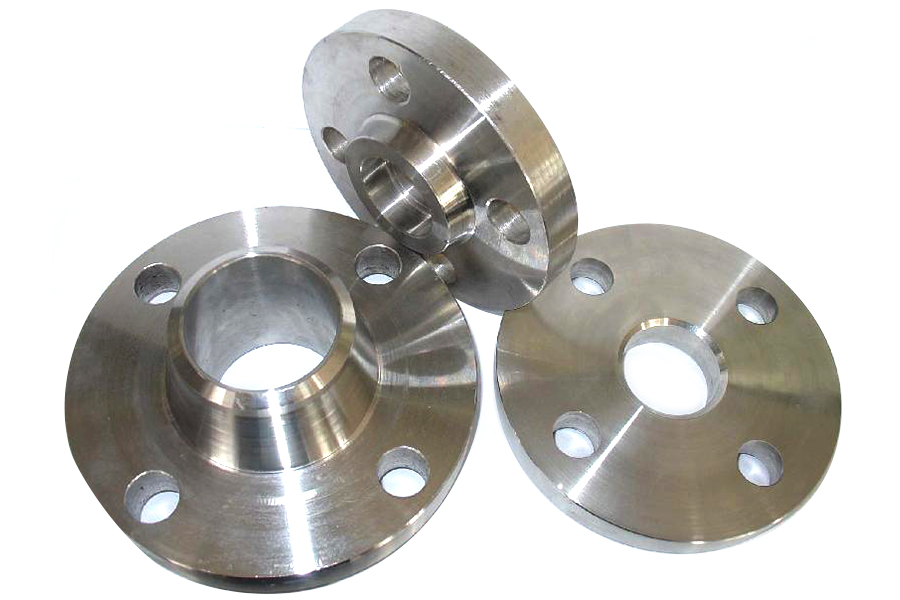
Common Types of 304L Stainless Steel Flanges
304L stainless steel flanges are manufactured in all of the standard flange types defined by ASME B16.5 (for pipe sizes NPS ½ through NPS 24) and ASME B16.47 (for larger sizes). Each flange type is designed for specific installation methods, pressure requirements, and operational conditions. Selecting the correct flange type for a given application is as important as selecting the correct material grade.
Weld Neck Flange
The weld neck flange is the most widely specified type for high-pressure and high-temperature piping systems. It features a long tapered hub that is butt-welded to the pipe, creating a smooth bore transition that minimizes turbulence and stress concentration at the weld joint. The hub distributes stress from the flange face gradually into the pipe wall, making weld neck flanges the most structurally robust option for cyclic loading, high-pressure differentials, and applications involving bending moments on the piping system. In 304L, the butt-weld connection is ideal because the low carbon content prevents sensitization in the heat-affected zone of the weld.
Slip-On Flange
Slip-on flanges slide over the outside of the pipe and are then fillet-welded at both the hub face and the back of the flange. They are easier and faster to align during installation than weld neck flanges, making them popular for lower-pressure systems and applications where installation labor costs are a significant consideration. In 304L stainless steel, the double fillet weld configuration means the low-carbon grade's resistance to sensitization is directly relevant to the corrosion performance of the finished joint. Slip-on flanges have a lower pressure rating than weld neck flanges of equivalent size and class and are generally not recommended for services involving severe cyclic loading, elevated temperatures above 300°C, or significant bending moments.
Socket Weld Flange
Socket weld flanges are designed for small-bore piping (typically NPS ½ through NPS 2) and are connected by inserting the pipe into a recessed socket and applying a single fillet weld around the hub. They provide a stronger joint than threaded flanges for small-diameter high-pressure service but are not suitable for corrosive services where crevice corrosion in the annular gap between the pipe end and the socket bottom could be a problem. In 304L, this crevice sensitivity should be evaluated carefully for applications involving chloride-containing fluids or aggressive process chemicals where crevice attack is a known risk mechanism.
Blind Flange
Blind flanges are solid discs used to seal the end of a piping system, vessel nozzle, or pressure vessel opening. They are bolted against a mating flange with a gasket between the faces and must withstand the full system pressure acting across their entire face area, making them subject to significant bending stress. 304L blind flanges are specified wherever the service environment requires the corrosion resistance of the 304L grade at pipe terminations, inspection ports, and cleanout connections — applications common in food processing plants, pharmaceutical facilities, and chemical process systems.
Lap Joint Flange
Lap joint flanges are used in conjunction with a stub end fitting that is butt-welded to the pipe. The flange itself slides freely over the stub end and is not welded, allowing it to be rotated for bolt hole alignment during assembly and disassembly. This design is particularly useful in systems requiring frequent dismantling for inspection or cleaning, and in installations where alignment of bolt holes between mating flanges is difficult to achieve precisely. In 304L piping systems, the stub end is typically also specified in 304L to maintain consistent corrosion performance across the joint, while the backing flange — which does not contact the process fluid — can sometimes be specified in a lower-cost carbon steel if the external environment permits.
Pressure-Temperature Ratings and Applicable Standards
304L stainless steel flanges for pressure piping applications are governed by ASME B16.5, which defines pressure classes from Class 150 through Class 2500 for pipe sizes up to NPS 24. Each pressure class establishes the maximum allowable working pressure at a range of temperatures. Because 304L has a lower yield strength than standard 304, its pressure-temperature ratings are slightly lower than those for F304 flanges of the same class, though in most practical applications within the normal operating temperature range of process piping, the difference is modest and well within normal design margins.
The relevant material specification for forged 304L stainless steel flanges is ASTM A182 Grade F304L. This standard covers chemical composition, mechanical property requirements, heat treatment, and testing requirements for forged or rolled alloy and stainless steel pipe flanges, forged fittings, and valves. Flanges produced to A182 F304L must be supplied with a material test report (MTR) confirming that the chemical composition and mechanical properties of the specific heat of steel used comply with the standard. Buyers should always verify that MTRs reference the correct specification and grade, and that the carbon content is confirmed at or below 0.03% — the defining characteristic of the L grade.
Industries and Applications That Rely on 304L Stainless Steel Flanges
The combination of weldability, corrosion resistance, hygienic surface characteristics, and broad chemical compatibility makes 304L stainless steel flanges the default specification across a wide range of industries where piping integrity and process fluid purity are both important.
- Food and beverage processing: 304L flanges are used throughout food and beverage plants for process piping carrying milk, fruit juices, beer, wine, edible oils, and sugar solutions. The non-reactive surface, ease of cleaning, and resistance to the dilute organic acids present in many food products make 304L the standard hygienic piping material in this sector, with flanged connections facilitating the frequent disassembly required for cleaning-in-place (CIP) and sterilization-in-place (SIP) protocols.
- Pharmaceutical and biotechnology manufacturing: High-purity process piping in pharmaceutical plants uses 304L flanges with raised face or ring-type joint faces and electropolished bore surfaces to minimize bacterial adhesion and facilitate validated cleaning procedures. The low carbon content is essential because pharmaceutical piping systems are frequently welded and must maintain full corrosion resistance at all weld joints.
- Chemical processing: 304L flanges are used in chemical plants for services involving dilute acids, alkalis, alcohols, and a wide range of organic compounds where the chromium-nickel passivation layer provides adequate resistance. For more aggressive chemicals — concentrated acids, halide-containing streams, or high-temperature oxidizing environments — upgraded grades such as 316L, duplex, or higher-alloy stainless steels are specified instead.
- Cryogenic and LNG applications: The maintained toughness of 304L at sub-zero temperatures makes it a standard material for flanges in liquefied natural gas (LNG) transfer systems, cryogenic storage and distribution piping, and industrial gas handling systems operating at temperatures down to -196°C.
- Water treatment and distribution: Municipal water treatment plants, desalination facilities, and industrial water systems use 304L flanges for pipe connections handling treated water, chemical dosing lines, and filtration system piping where mild corrosive conditions are present but chloride concentrations remain below the threshold that would necessitate 316L.
- Pulp and paper: Digesters, bleach plant piping, and chemical recovery systems in pulp mills use 304L flanges for services involving white liquor, weak black liquor, and dilute bleaching chemicals where the grade's corrosion resistance profile is adequate and cost efficiency compared to higher alloys is a procurement priority.
304L vs. 316L Flanges: Choosing the Right Grade
The most common material selection decision in stainless steel flange procurement is the choice between 304L and 316L. Both are low-carbon austenitic grades with similar mechanical properties and weldability, but 316L contains approximately 2%–3% molybdenum that significantly enhances its resistance to pitting and crevice corrosion in chloride-containing environments. This makes 316L the preferred grade for seawater service, coastal installations, food processes involving salt brines, and any application where chloride concentration or temperature is high enough to compromise 304L's passive film.
For services where chloride exposure is low or absent — pure water, dilute organic acids, most food products, pharmaceutical process streams, and ambient-temperature chemical services — 304L provides fully adequate corrosion resistance at a lower material cost than 316L. The cost premium for 316L flanges, which typically ranges from 20% to 40% over equivalent 304L flanges depending on size and market conditions, is only justified when the molybdenum addition is genuinely needed to prevent corrosion in the specific service environment. Specifying 316L as a blanket upgrade without corrosion engineering justification adds unnecessary cost to projects without providing a proportionate benefit.
Key Considerations When Sourcing 304L Stainless Steel Flanges
Procuring 304L stainless steel flanges for pressure piping applications requires attention to several documentation, quality, and dimensional considerations that go beyond simply confirming the material grade. The following checklist covers the most critical points for procurement engineers and project buyers.
- Verify ASTM A182 F304L certification: Require a material test report for every heat of material used, confirming carbon content at or below 0.03%, full chemical composition within A182 F304L limits, and mechanical properties at or above minimum requirements. Do not accept generic "304/304L" dual-certified material without confirming the carbon content meets the L grade maximum.
- Confirm dimensional standard compliance: Specify whether flanges must comply with ASME B16.5, ASME B16.47 Series A or B, EN 1092-1, or another dimensional standard applicable to your project. Flanges manufactured to different standards are not interchangeable even when specified in the same pressure class and nominal pipe size.
- Specify face finish: Raised face (RF), flat face (FF), and ring-type joint (RTJ) are the most common face configurations. The face finish — typically 125–250 AARH for raised face flanges in standard service — must be compatible with the gasket type specified for the joint. Confirm face type and finish requirements before ordering.
- Check heat and lot traceability: For critical process and pressure piping applications, require full heat and lot traceability linking each flange to its MTR, manufacturing record, and inspection documentation. This traceability is essential for quality audits, insurance inspections, and incident investigations.
- Confirm country of origin and third-party inspection requirements: For projects subject to owner specifications or regulatory requirements regarding country of manufacture, confirm origin documentation. For high-integrity applications, consider specifying third-party inspection by an approved inspection agency at the manufacturer's facility prior to shipment.