

 English
 русский
 عربى
عربى 中文简体
中文简体
Content
If you have ever waited three weeks for a delivery of elbows, only to find that the wall thickness does not match the mill certificate, you already know that sourcing 304 stainless steel pipe fittings is a supply chain decision, not simply a purchasing one. Fittings sit at the joints of a piping system, and joints are where leaks, vibration fatigue and crevice corrosion tend to appear first.
We are Wuxi Chengfeng Metal Technology Co., Ltd. We trade and stock stainless steel and nickel alloy materials, and we also machine and fabricate parts to customer drawings. Most of what leaves our floor falls into two groups: standard 304 fittings, pipes, plates and profiles taken from stock, and non-standard components built from a drawing. What follows is close to what we tell a new buyer during the first phone call.
What 304 Actually Tells You About a Fitting
Grade 304 is the workhorse austenitic stainless steel: roughly 18 percent chromium and 8 percent nickel, non-magnetic in the annealed condition, and resistant to a wide range of organic and mildly oxidizing media. It is dependable, but the grade name alone says very little about whether a fitting will fit properly and last.
Three distinctions come up again and again in our inbox:
- 304 or 304L. The low-carbon version keeps carbon at 0.030 percent or below, which reduces the risk of sensitization and intergranular corrosion in weld heat-affected zones. Thick-wall fittings, and anything welded without post-weld solution annealing, are safer in 304L.
- Product standard or dimensional standard. ASTM A403 covers wrought austenitic fittings, ASTM A182 covers forged flanges, while ASME B16.9 and ASME B16.5 define the dimensions. A supplier who can answer both parts of that question is usually working from real documentation.
- Schedule and end preparation. Sch 10, Sch 40 and Sch 80 wall thicknesses are not interchangeable, and a beveled end for butt welding is not the same as a threaded or socket-welded end.
A purchase order that names grade, product standard, dimensional standard, schedule, end type, surface condition, certification and marking is far harder to get wrong than one that says only "304 elbow". That list is worth keeping as a template.
The 304 Fittings Our Customers Ask For Most
Industrial piping packages usually need a small, repeatable set of components. The table below lists what moves most often through our warehouse and workshop, together with the details worth confirming on each.
| Fitting | Where it is used | Typical standard | Points to confirm |
|---|---|---|---|
| 90 degree elbow | Direction changes in process and utility lines | ASME B16.9 | Center-to-end radius, bevel angle, wall thickness |
| Equal and reducing tee | Branch take-offs and instrument connections | ASME B16.9 | Run and branch schedule, branch reinforcement |
| Concentric and eccentric reducer | Line size transitions and pump suction piping | ASME B16.9 | Orientation for drainage, length, end match |
| Cap and plug | Line ends, future tie-in points, hydro testing | ASME B16.9 | Dome thickness, marking, thread form if threaded |
| Coupling and union | Small bore connections and maintenance joints | ASME B16.11 | Thread type (NPT or BSP), pressure class |
| Weld neck and slip-on flange | Equipment nozzles, valve and instrument connections | ASME B16.5 | Face type, bore, hub dimensions, bolt circle |
| Stub end and lap joint | Lines that need frequent dismantling or alignment | ASME B16.9 / B16.5 | Mating flange series, length, squareness |
If one item decides whether a spool goes together on site or comes back to the shop, it is the elbow. Center-to-end dimensions, wall thickness and bevel preparation all have to line up with the pipe it will be welded to, and a small deviation multiplies across a long run.
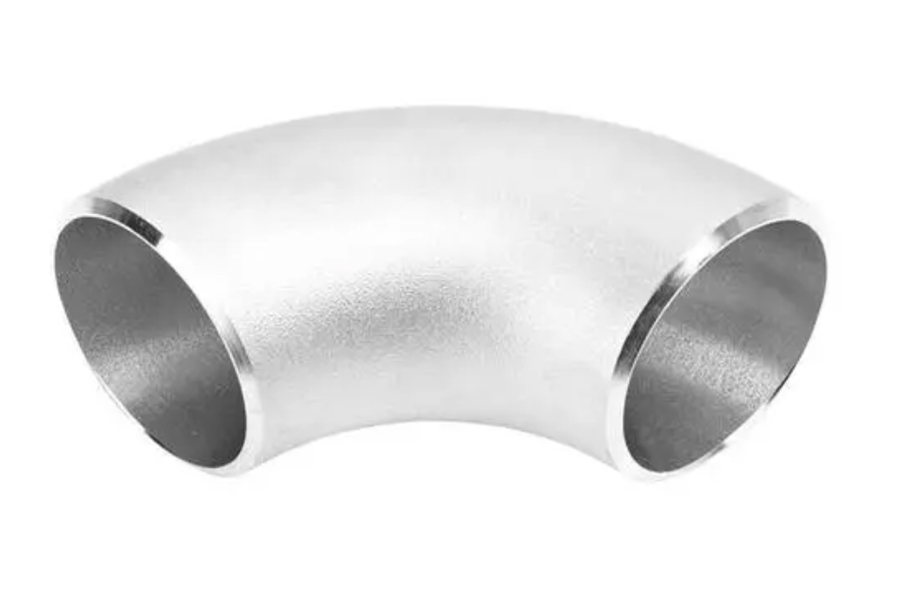 Stainless Steel Elbow ManufacturersCopyright 2024 © Wuxi Chengfeng Metal Technology Co., Ltd. All Rights Reserved. Custom 304, 304L, 316L Stainless Steel Elbow SuppliersView Product →
Tees and reducers cause fewer arguments, but the branch schedule and the orientation of an eccentric reducer still deserve a second look on the drawing before the order is released.
How to Judge a 304 Pipe Fittings Supplier
Price is the easiest thing to compare and the least useful on its own. When we sit on the buying side of the table, this is the order we work through.
Traceability and documentation
Ask for a mill test certificate to EN 10204 3.1 as a default rather than an upgrade. Heat numbers on the fittings, on the certificate and on the packing list should agree with one another. For regulated industries, positive material identification on a sample of the delivered lot closes the last gap between paperwork and metal.
Dimensional and surface inspection
Wall thickness tolerance, out-of-round, bevel angle and face squareness are checked against the dimensional standard quoted in the order. Pickled and passivated surfaces should be free of embedded iron, heat tint and heavy scale; fittings handled with carbon steel tools or stored outdoors tend to show these problems quickly.
Stock position and realistic lead time
Lead time is not only about production speed. It is also about whether the material is already sitting in a yard. Our own material warehouse holds around 20,000 tons of coil, which is what allows us to quote short delivery on standard items while custom work is still in the drawing review stage.
Packing for the journey
Sea freight is unforgiving. End caps, wooden cases, moisture protection and clear marking on the outside of each package save more time than most buyers expect, particularly when a container is split across several sites.
Questions Worth Asking Before You Release a Purchase Order
- Which mill produced the fittings, and can heat numbers be confirmed before shipment?
- Will the certificate be EN 10204 3.1, and will it list chemistry, mechanical properties and the applicable standard?
- Are dimensions to ASME B16.9 and B16.5, or to EN 10253? If a project mixes both, say so early.
- Is the material 304 or 304L, and will one shipment contain mixed heats?
- What is the lead time from stock compared with made-to-order sizes?
- Can a small trial order be arranged before the full package?
When Standard 304 Fittings Are Not Enough
Sooner or later a project needs something no catalogue covers: a flange with a specific bolt pattern and facing, a jacketed flange for a heated line, or a bend with a non-standard radius that must match existing pipework. These are the jobs where the conversation moves from stock lists to drawings, and where the questions about material grade and welding procedure become much more specific.
We handle that step in-house. Drawings are reviewed by our technical team, the material is drawn from our own stock, and the finished part is inspected before it is packed.
Adding Machining and Fabrication to the Same Package
Standard fittings and custom parts often travel together on one order. Alongside elbows, tees and flanges, we turn, mill, drill and bore stainless and copper components, plasma weld pipe spools, and assemble welded structures such as cylinders and tanks. For a maintenance team working against a shutdown window, having the fitting, the matching pipe and the one-off machined part come from a single chain of responsibility removes a great deal of coordination work.
If you would like a broader overview of the different types of pipe fittings and where each is normally used, our technical notes cover the subject in more detail.
Stainless steel pipe fittings: durable and versatile pipe connection solutions
Choosing among 304 stainless steel pipe fittings suppliers comes down to a handful of practical things: whether the documentation matches the metal, whether the tolerances hold up on site, and whether the supplier can actually deliver when the schedule tightens. A supplier who stocks the pipe as well as the fittings, sells in the quantities you need, and can machine a one-off part without sending it somewhere else shortens the chain in a way that is difficult to price but easy to notice.
If you want a straight answer on availability, tolerances or lead time, send us your drawing or your bill of materials, and we will tell you plainly what we can supply from stock and what we will make.
Contact our team with your specification, and we will come back with a realistic answer rather than a hopeful one.