

 English
 русский
 عربى
عربى 中文简体
中文简体
Content
- 1 What Is Stainless Steel Angle?
- 2 Common Grades and How to Choose Them
- 3 Standard Sizes, Tolerances, and Surface Finishes
- 4 Why Stainless Steel Angle Performs So Well
- 5 Where Stainless Steel Angle Is Used
- 6 Fabrication Notes: Cutting, Drilling, and Welding
- 7 How to Select the Right Angle for Your Project
- 8 Sourcing Stainless Steel Angle with Confidence
- 9 Final Thoughts
Walk into almost any fabrication workshop and you will find a rack of it near the door: stainless steel angle. The simple L-shaped section is one of the most practical structural materials in modern industry, quietly doing the heavy work behind handrails, equipment frames, support brackets, and load-bearing platforms.
What makes it so useful is the combination of a familiar shape and a material that does not rust away in the first wet season. The two legs meet at a right angle, giving the profile stiffness in two directions at once, while the stainless alloy keeps it clean, strong, and almost maintenance-free.
In this guide we share what we have learned from supplying and processing stainless steel angle for industrial customers: which grades matter, which sizes are standard, how the material behaves during fabrication, and how to match a specification to your project.
What Is Stainless Steel Angle?
Stainless steel angle, also called angle bar or angle steel, is a long product with an L-shaped cross section. Both legs are usually the same length — equal leg angle — but unequal leg angle is produced when space or load distribution calls for it. Size is written as leg length x leg length x thickness, for example 50 x 50 x 5 mm.
Most angle is hot rolled from stainless billet, producing a strong profile with slightly rounded edges and a mill or pickled finish. Cold drawn angle is pulled through a die instead, which gives tighter dimensional tolerance, sharper corners, and a brighter surface — often preferred for visible architectural work or precision assemblies. The rounded root radius where the two legs meet is a normal part of the profile, not a defect.
Common Grades and How to Choose Them
Grade selection is the single most important decision you will make, because the alloy decides how the angle behaves in humidity, salt spray, acids, and heat.
| Grade | Key Alloying Elements | Corrosion Resistance | Typical Use |
|---|---|---|---|
| 201 | Manganese, chromium, low nickel | Moderate | Indoor frames, cost-sensitive trim |
| 304 / 304L | 18% Cr, 8% Ni | Good | General fabrication, food equipment, architecture |
| 316 / 316L | 16–18% Cr, 10–14% Ni, 2–3% Mo | Excellent | Marine, coastal, chemical, pharmaceutical |
| 321 | Chromium, nickel, titanium stabilized | Good at high temperature | Exhaust systems, heat exchangers |
| 2205 duplex | 22% Cr, 5% Ni, molybdenum, nitrogen | Very high | Offshore structures, pulp and paper, heavy frames |
As a rule of thumb, 304 handles most indoor and general industrial work, while 316 is the safer answer whenever chlorides, sea air, or aggressive cleaning chemicals are involved. Duplex grades cost more but bring roughly double the yield strength of 304, which lets you use a lighter section for the same load.
Standard Sizes, Tolerances, and Surface Finishes
Equal leg angle is normally stocked from 20 x 20 mm up to 200 x 200 mm, with thicknesses between 3 mm and 20 mm. Common working sizes include 25, 30, 40, 50, 63, 75, and 100 mm legs. Standard delivery lengths are 6 m, 9 m, and 12 m, and cut-to-length service is available when you need fixed pieces for a production line rather than full bars.
Hot rolled angle carries normal mill tolerances on leg length, thickness, and straightness. Cold drawn angle holds much tighter tolerances, which matters when the profile has to slide into a machined slot or align with a jig. Surface options include hot rolled pickled finish, bright cold drawn finish, and brushed or satin finishes for parts that remain visible.
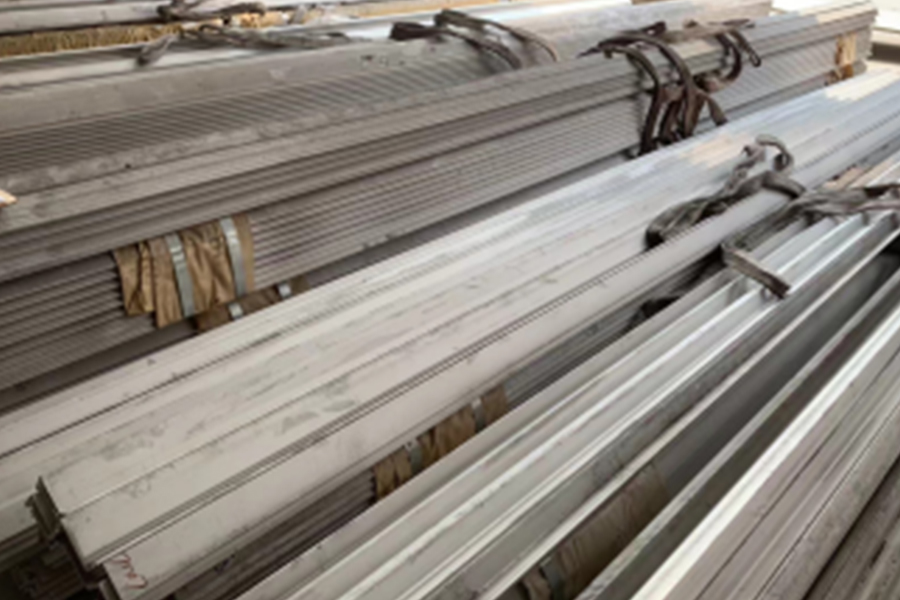 Stainless Steel Angle ManufacturersStainless steel angleView Product →
Why Stainless Steel Angle Performs So Well
- Corrosion resistance: the chromium-rich passive layer renews itself in air, so the surface keeps protecting the core even after minor scratches.
- Strength with low weight: the L shape resists bending in two directions, delivering stiffness without a heavy solid section.
- Hygiene and easy cleaning: smooth, non-porous surfaces suit food, beverage, and pharmaceutical environments.
- Temperature tolerance: austenitic and stabilized grades keep useful strength at elevated service temperatures.
- Low lifecycle cost: no painting, plating, or re-coating, plus a high scrap value at end of life.
- Recyclability: stainless steel is fully recyclable, which supports sustainability targets in construction and manufacturing.
Where Stainless Steel Angle Is Used
The application list is broader than most people expect:
- Construction and architecture: support frames, curtain wall brackets, stair stringers, balustrades, and cladding supports.
- Marine and offshore: dock ladders, platform handrails, vessel frames, and deck supports. Salt spray is unforgiving, which is why marine fabricators almost always specify 316 or duplex; our note on stainless steel profiles in marine environments covers that reasoning in more detail.
- Food and beverage processing: conveyor frames, wash-down supports, table legs, and equipment guarding.
- Chemical, petrochemical, and water treatment: pipe racks, tank supports, walkways, and filter housing frames.
- Powder handling and bulk solids: brackets and supports for silos, ducts, and conveying systems where dust and moisture are constant.
- Transportation and energy: rail and bus interior frames, exhaust supports, solar mounting, and battery enclosures.
Angle is often used alongside other long products in the same structure. Channel, flat bar, round bar, and I-beam are frequently combined with angle to complete a frame, and sourcing them together keeps dimensions and grades consistent.
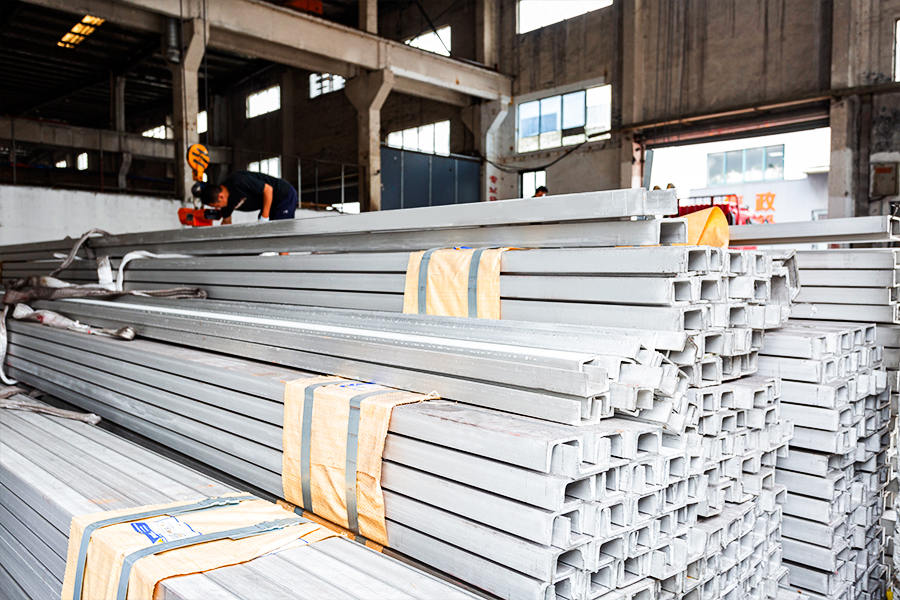 Stainless Steel Profiles ManufacturersStainless Steel Channel SteelView Product →
Fabrication Notes: Cutting, Drilling, and Welding
Cutting and drilling
Angle can be cut with an abrasive saw, band saw, plasma, or laser. Stainless steel work-hardens, so steady feed rates and sharp tooling matter more than raw speed. Drilling close to the root radius is best avoided, because the section is thicker there and the drill tends to wander.
Welding
304 and 316 weld cleanly with TIG or MIG using a matching filler. Keep heat input controlled, use stainless-only brushes and tools, and clean the joint before welding. After welding, pickling or passivation restores the passive layer around the heat-affected zone.
Forming
Small sections can be bent or notched, but remember that cold working reduces ductility. If a part needs tight radii or repeated bends, tell your supplier so a softer temper or a different grade can be selected.
When a project needs more than a cut length — machined brackets, drilled spacer blocks, or precision fittings — that work can be handled in-house instead of being split across several vendors.
How to Select the Right Angle for Your Project
A simple sequence keeps specification mistakes out of the order:
- Describe the service environment: indoor, coastal, chemical, or high temperature.
- Confirm the loads and spans so the leg size and thickness are adequate.
- Match the grade to the exposure — 304 for general work, 316 where chlorides are present.
- Check dimensional tolerances, especially if the part interacts with machined components.
- Decide on the surface finish: mill, pickled, bright, or brushed.
- Request mill test certificates and confirm heat number traceability.
- Plan cutting, drilling, and welding steps before the material arrives.
Sourcing Stainless Steel Angle with Confidence
Wuxi Chengfeng Metal Technology works as both a material supplier and a fabrication partner, so a single order can cover standard angle bars as well as the non-standard parts built around them. Our warehouse holds around 20,000 tons of coil stock, which gives customers a stable supply base and shorter lead times than spot purchasing allows.
Our technical team reads customer drawings in detail, produces the required components, and inspects each item before dispatch. Experienced welders and fitters handle assembly, while the quality team checks dimensions, finish, and material documentation. That combination supports the long-term supply relationships we maintain with listed companies, state-owned enterprises, and international manufacturers.
Final Thoughts
Stainless steel angle is a small line item that decides how long a frame, platform, or production line stays in service. Choosing the right grade, size, and finish early avoids callbacks later, and buying from a supplier who understands fabrication saves a great deal of trouble at the bench.
Tell us the application and the environment, and we will recommend the grade and dimensions that fit it — get in touch with our team for pricing, samples, or technical support.