

 English
 русский
 عربى
عربى 中文简体
中文简体
Content
- 1 Why 304 Is the Default Grade for Industrial Pipe Systems
- 2 Common Types of 304 Stainless Steel Pipe Fittings
- 3 Material Specifications and Surface Finish
- 4 Pressure Ratings and Dimensional Standards
- 5 How to Select the Right 304 Fittings for Your Application
- 6 Sourcing Considerations and Mill-Linked Supply
You are about to order 304 stainless steel pipe fittings for a process line, and the first question is usually whether grade 304 will be sufficient. In most clean-fluid systems, food processing plants, and low-chloride industrial lines, the answer is yes. The fittings will match the corrosion resistance of 304 pipe only when the type, manufacturing standard, and surface condition are specified together. If any one of those three variables is left open, you risk leaks, premature pitting, or a failed audit. The sections below walk through the decisions that matter.
Why 304 Is the Default Grade for Industrial Pipe Systems
Type 304 stainless steel contains roughly 18% chromium and 8% nickel. The chromium forms a self-repairing oxide layer that gives the alloy its corrosion resistance, while the nickel stabilizes the austenitic structure for good formability and weldability. It is not the most corrosion-resistant stainless grade available, but it is the most practical one for neutral fluids, organic media, steam, and dry chemicals. It also resists oxidation up to about 870 degrees Celsius in intermittent service, which covers most pipe fitting applications outside of high-chloride environments.
For seawater, strong chloride solutions, or equipment exposed to de-icing salts, 316 or 316L is a safer choice. The distinction matters because a fitting with identical dimensions but different material will behave very differently in the field. If your specification sheet does not state the grade clearly, ask the supplier to confirm both the material standard and heat number before production.
Common Types of 304 Stainless Steel Pipe Fittings
Standard stainless steel pipe fittings fall into a small set of geometries, and each one solves a specific routing problem:
- Elbows: 45-degree, 90-degree, and 180-degree elbows change the direction of flow. For butt-welding elbows, long-radius (1.5D) is the default; short-radius (1D) is available for space-constrained layouts.
- Tees and crosses: create branch lines at 90 degrees.
- Reducers and expanders: transition between different pipe diameters and maintain a smooth flow path.
- Couplings and unions: connect two straight pipe sections; unions allow quick disconnection for maintenance.
- Caps and plugs: close the end of a pipe or a fitting opening.
- Flanges: connect pipe to equipment, valves, or another pipe using bolted joints.
Connection methods add another layer of selection. Butt-welding fittings (ASME B16.9) are used where full weld strength and smooth bores are required. Threaded and socket-welding fittings (ASME B16.11) suit smaller bore sizes up to 2 inches. Flanged connections are preferred when disassembly is needed for maintenance. Keep the connection type in mind while selecting because the fitting end must match your pipe schedule and joining procedure.
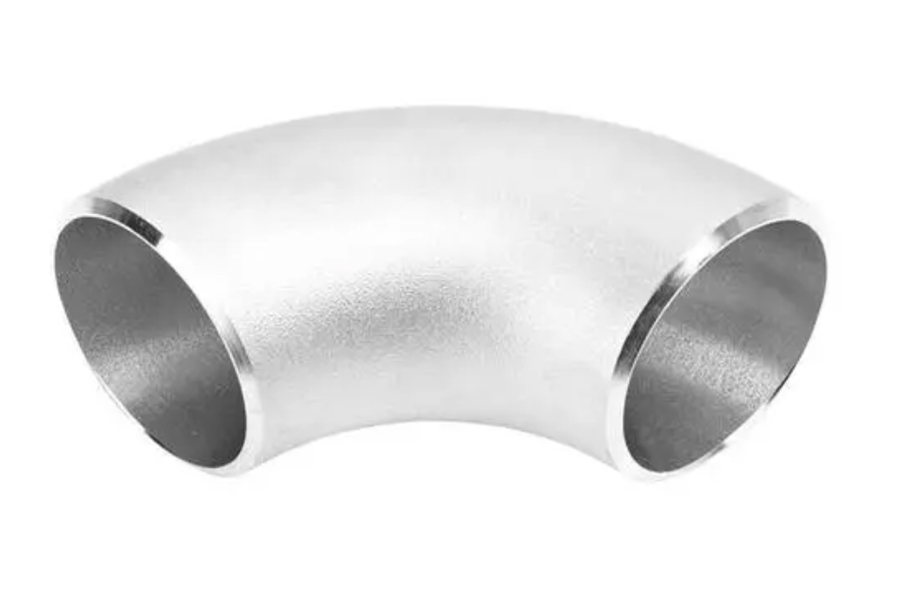 Stainless Steel Elbow Options for Pipe Direction ChangesThis page covers stainless steel elbows available in 45°, 90°, and 18° angles, with sizes starting at 1/2 inch. Useful when choosing the right fitting for your pipeline's bend requirements and connection method.View Product →
Material Specifications and Surface Finish
304 fittings are normally supplied in a pickled and passivated condition, which restores the surface after hot forming. For hygienic or clean-media applications, buyers specify a 2B finish, a bright annealed (BA) surface, or a mechanically polished finish such as 240-grit or 400-grit. The surface condition directly affects cleanability and bacteria retention in food, pharmaceutical, and bioprocess lines. The table below summarizes the finishes commonly ordered for 304 pipe fittings.
| Surface condition | Typical application | Typical roughness |
|---|---|---|
| Pickled / passivated | Industrial fluid lines | Not specified |
| 2B cold-rolled | General process piping | About 0.4 to 1.2 micron |
| BA bright annealed | Food and beverage | About 0.1 to 0.4 micron |
| Mechanical polish 240 to 400 grit | Sanitary or cosmetic | About 0.2 to 0.8 micron |
Flange faces and gasket grooves have their own finish requirements, especially in low-emission or high-pressure services. If your plant has a surface-finish specification, pass it to the manufacturer so the fitting is not shipped with the wrong industrial finish.
Pressure Ratings and Dimensional Standards
Pressure capacity for 304 stainless steel pipe fittings is tied to wall thickness and the design code. In the North American system, butt-welding fittings follow ASME B16.9, while socket-welding and threaded fittings follow ASME B16.11. Wall thickness is expressed as Schedule 10S, 40S, or 80S. A heavier pipe schedule does not automatically mean a higher pressure class in flanged connections; the class rating for flanges, such as 150 or 300, is defined separately by ASME B16.5. For material requirements, ASTM A403 covers wrought austenitic stainless steel fittings and uses grade designations such as WP304.
- ASME B16.9: factory-made wrought butt-welding fittings; covers dimensions, tolerances, and marking.
- ASME B16.11: socket-welding and threaded fittings for small-bore piping.
- ASME B16.5: pipe flanges and flanged fittings; pressure-temperature ratings up to the 2500 class.
- ASTM A403: material specification for wrought austenitic stainless steel fittings; the WP304 designation indicates the base material grade and manufacturing route.
On a new project, write the schedule and the dimensional standard into the purchase order. A 90-degree elbow in Schedule 40S and Schedule 80S has different outside diameters at the bevel and different weld prep; mixing schedules between pipe and fitting creates fit-up problems and residual stress.
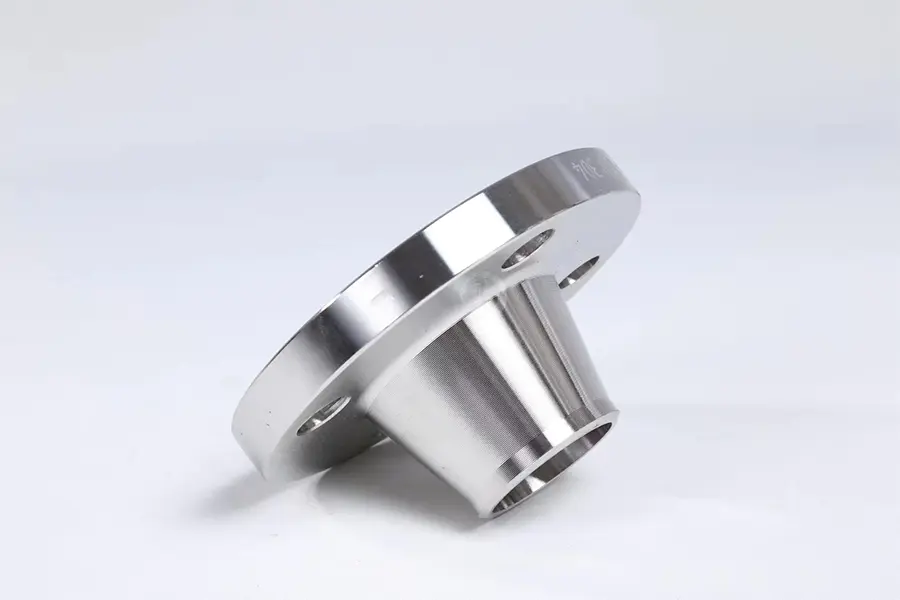 Stainless Steel Flange Types for Pipe and Valve ConnectionsThis listing presents stainless steel flanges in reducing, pressure vessel, and threaded styles, with diameters from DN8 to DN3000. Relevant when planning flanged connections that require disassembly or matching specific standards.View Product →
How to Select the Right 304 Fittings for Your Application
Start by defining the service environment, not the part number. You need to know whether the process fluid is clean, chlorinated, abrasive, or exposed to cyclic temperatures. Then match the connection type to maintenance access and welding capability. Finally, confirm the documentation: material certificate, heat number, dimensional report, and pressure test records where required by the code. If a fitting is cast instead of wrought, the applicable material standard changes, so check the product label.
- Determine the design pressure and temperature; select the wall schedule or flange class accordingly.
- List the fluid and its chloride level; keep 304 below roughly 200 ppm of chlorides in aqueous service at ambient temperature.
- Choose the connection method based on installation access and future disassembly needs.
- Verify dimensional tolerances, surface finish, and the applicable standard in the supplier quotation.
- Confirm the thread standard for threaded fittings; NPT and BSP threads are not interchangeable.
One common procurement risk is receiving fittings from a non-integrated trader who cannot provide traceable mill test certificates. A mill-linked supplier normally keeps the heat trace for each batch and can issue EN 10204 3.1 or ASTM certification without delay. For any fitting intended for a pressure system, do not skip this step. To see how these decisions are applied across common industrial connection systems, read our overview of stainless steel pipe fittings and connection solutions.
Sourcing Considerations and Mill-Linked Supply
When you buy 304 stainless steel pipe fittings through a distributor, you often pay for multiple warehousing steps. When you order from a factory with its own material stock and processing lines, the chain is shorter. Wuxi Chengfeng Metal Technology operates with a stainless steel inventory of around 20,000 tons of coils and plates, which gives it direct access to base material for producing flanges, elbows, and other fittings on demand. The factory also handles custom forming, welding, and testing, so non-standard angles and special face finishes do not require a separate supplier.
For procurement teams, the practical benefits are traceable certificates, faster delivery for small batches, and the ability to request dimensional or surface inspection before shipment. If you are working from a drawing rather than a product name, include the drawing number and tolerance requirements in the request. You can contact the technical team directly to confirm that the fitting will be made to your standard.
Range of Stainless Steel Pipe Fittings for Various ApplicationsThis overview includes stainless steel elbows, flanges, tees, reducers, and caps made from 304, 304L, 316, and 316L. Helpful for procurement teams needing traceable certificates and confirmation of dimensional standards before shipment.View Product →Choosing 304 stainless steel pipe fittings is less about finding a part and more about defining the interface between your pipe, your process fluid, and your maintenance strategy. When the grade, standard, and documentation align, the fitting disappears into the background and does its job for the life of the plant.