

 English
 русский
 عربى
 中文简体

Content
- 1 Why 316 Stainless Steel Pipe Fittings Get Specified
- 2 What the 316 Designation Actually Changes
- 3 A Quick Tour of the Fitting Family
- 4 Flanges and Other Connection Choices
- 5 Standards, Dimensions and Tolerances Worth Confirming
- 6 Applications Where 316 Pays You Back
- 7 Fitting It Together: Installation Notes
- 8 Inspection Points Before the Container Ships
- 9 When a Standard Fitting Will Not Do
Some fittings fail quietly: a pinhole at a weld toe, a thread that starts weeping after two winters, a flange face pitted where the gasket used to seat. Others simply keep working for twenty years. The difference is rarely the workshop that installed them. It is the alloy that was chosen and the discipline of the mill that made it, and 316 stainless steel pipe fittings sit right at the centre of that conversation.
What follows is written from the shop floor and the loading bay rather than from a catalogue: how 316 behaves, which fitting types you will actually be quoted, what to check on the certificate, and where a standard part stops being the sensible answer.
Why 316 Stainless Steel Pipe Fittings Get Specified
316 is an austenitic grade built on roughly 16–18% chromium, 10–14% nickel and 2–3% molybdenum. Chromium forms the passive film that makes stainless steel stainless; molybdenum is the part that matters here, because it helps that film survive when chloride ions try to punch through it. A 304 elbow that pits within a year on a coastal cooling loop will often give a decade or more in 316 under the same duty.
It is worth being honest about the limits, though. Hot, concentrated chlorides — chlorinated water above roughly 60 °C, bleach transfer lines, strong brine — can still attack 316, and genuine seawater service usually belongs to a super duplex or 6% molybdenum grade. Knowing where that boundary sits is far more useful than assuming that a higher number solves everything.
What the 316 Designation Actually Changes
New buyers are often surprised to find that 316 and 316L are frequently sold as the same fitting. Their carbon content differs: standard 316 allows up to 0.08% carbon, while the L grade holds it at 0.03% or below. For thin-wall fittings welded in the field, the L grade is the safer call, because lower carbon leaves less opportunity for chromium carbides to form along the weld and sensitise the heat-affected zone.
In practice most mills now dual-certify fittings as 316/316L, which covers both specifications. Ask for the mill certificate to confirm it, then match the heat number on that document against the marking stamped on the fitting itself.
| Grade | Molybdenum | Typical chloride setting | Practical note |
|---|---|---|---|
| 304 / 304L | None | Indoor, fresh water, mild atmosphere | Lowest cost; watch for pitting in coastal air |
| 316 | 2–3% | Coastal plant, chlorinated water, food lines | General-purpose chloride workhorse |
| 316L | 2–3%, low carbon | As 316, plus welded assemblies | Preferred where field welding is unavoidable |
A Quick Tour of the Fitting Family
Most enquiries come down to a handful of shapes, and once you know what each one does, sizing a line becomes straightforward. If you would like a wider view of how these parts combine into a working system, our note on durable pipe connection solutions walks through the broader picture.
- Elbows in 90° and 45°, long radius for lower pressure drop, short radius where space is tight.
- Tees, equal and reducing, for branch take-offs on headers and manifolds.
- Concentric and eccentric reducers for line-size changes, the eccentric version being the usual choice on pump suction to avoid air pockets.
- Couplings, half-couplings, caps, plugs, unions and stub ends for terminations and future maintenance points.
- Nipples and barrel nipples in threaded or plain-end form for short spool pieces.
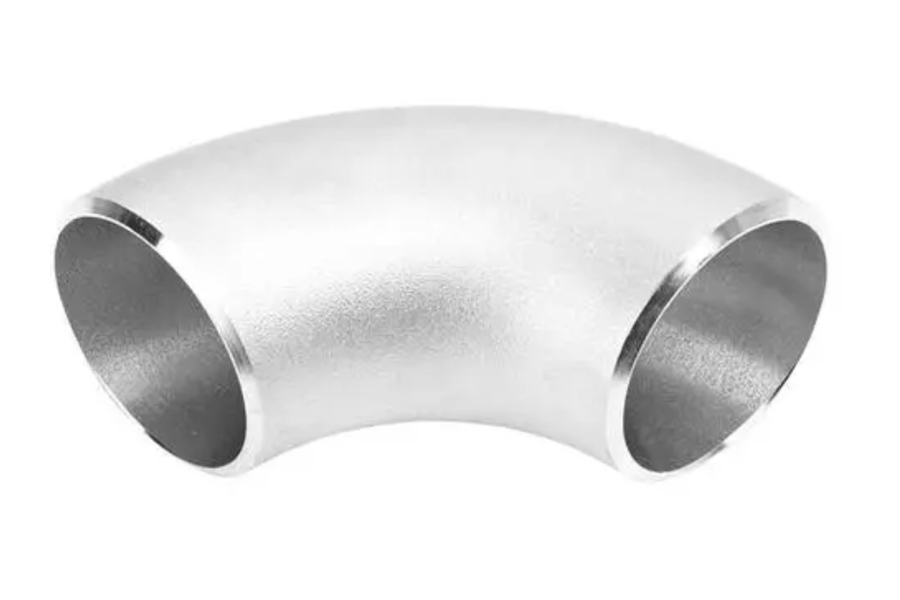 Stainless Steel Pipe Elbows in 304, 304L and 316LOffered in seamless or welded forms with multiple schedules and end preparations, these elbows help match line direction, schedule and connection type.View Product →
Each shape is normally offered in seamless (A403 WP-S) or welded (WP-W) construction, in schedules from 10S through 80S and heavier, with ends prepared for butt welding, threading or socket welding. Tell us the schedule and the end type at the quotation stage and you avoid the classic mismatch of a Sch 40 fitting landing on a Sch 10 pipe.
Flanges and Other Connection Choices
Flanges are where projects tend to accumulate small errors. A weld-neck flange suits high-pressure or cyclic service because the tapered hub spreads stress into the pipe; a slip-on is cheaper and easier to align but carries less fatigue capacity; a blind closes a line or a future tie-in point; a lap-joint pair lets you rotate a stub end without disturbing the pipe. Threaded and sanitary clamp connections appear wherever dismantling matters more than pressure rating.
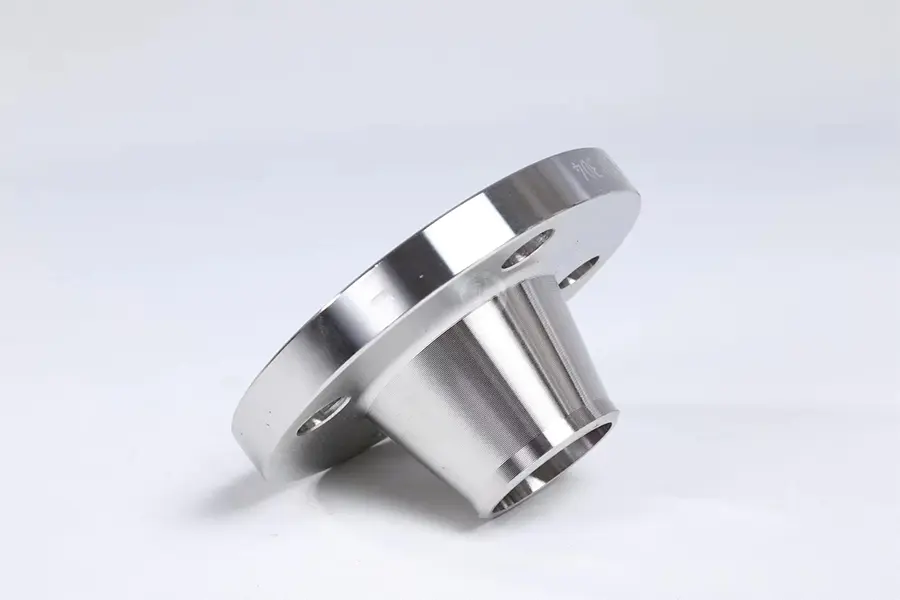 Stainless Steel Flanges for Pipe, Valve and Equipment ConnectionsAvailable as weld-neck, slip-on, blind, lap-joint, threaded and sanitary types; check facing and pressure class before ordering.View Product →
Two details deserve attention before ordering: the facing (raised face, flat face or ring joint) and the pressure class, because a PN16 flange will not bolt happily to an ANSI 150 counterpart even when the bore matches.
Standards, Dimensions and Tolerances Worth Confirming
Standards are the language of the trade, and being explicit at the enquiry stage saves weeks later. The documents you will most often see referenced are:
- ASTM A403 for wrought austenitic fittings and A182 for forged flanges and forged fittings.
- ASTM A312 for the matching pipe, so that wall thickness and bore align.
- EN 10253-4, with DIN 2605, 2615 and 2616 covering elbow, tee and reducer dimensions.
- JIS B2311 and B2312 for Japanese dimensional practice.
- MSS SP-43 and SP-79 for light-wall and stub-end details.
- EN 10204 3.1 certificates where traceability is a contractual requirement.
Center-to-face dimensions, bevel angle, wall thickness tolerance and surface finish are the four items we check first on incoming stock, because they are the ones that cause rework on site.
Applications Where 316 Pays You Back
The grade earns its premium wherever cleaning chemicals, salts or humidity are routine rather than exceptional:
- Brewery and dairy lines, where clean-in-place cycles alternate caustic and nitric washes.
- Pharmaceutical and purified-water loops requiring smooth, corrosion-resistant internal surfaces.
- Reverse osmosis skids, dosing manifolds and water treatment headers exposed to chlorides and antiscalants.
- Marine deck drains, exhaust runs and shipboard service piping in salt-laden air.
- Chemical dosing and transfer lines handling dilute acids and neutral salts.
- Pool plant, architectural handrails and coastal structural spools where appearance matters as much as corrosion resistance.
Fitting It Together: Installation Notes
- Verify the certificate and heat number against the fitting marking before anything is cut.
- Cut pipe square with a dedicated stainless wheel or plasma; carbon steel tooling leaves free iron that seeds rust.
- Purge the bore with argon during GTAW, and keep heat input modest, especially on 316L thin walls.
- Tack in three or four evenly spaced points, then complete the root before filling the cap.
- Clean between passes and avoid over-polishing threads, which thins the load-bearing flank.
- Hydro-test, then passivate any ground or brushed area so the passive film is restored uniformly.
Inspection Points Before the Container Ships
- Dimensional check of outside diameter, wall thickness and center-to-face against the ordered standard.
- Positive material identification with X-ray fluorescence to confirm molybdenum is genuinely present.
- Visual and dye-penetrant inspection of welds on welded fittings, with no undercut or oxidation scale.
- Thread gauging on threaded items, and bevel angle checks on butt-weld ends.
- Surface freedom from iron contamination, oil and grinding burn.
- Packing that protects machined faces and keeps fittings from rubbing during transit.
When a Standard Fitting Will Not Do
Sooner or later a layout simply refuses to cooperate. A tie-in needs a 30° sweep, a jacketed flange has to fit a fixed nozzle spacing, a header needs a half-pipe jacket, or a skid needs a plasma-welded spool lifted into place in one piece. That is the point where catalogue items stop and drawing-based fabrication starts.
Working from customer drawings is a familiar routine for us: our technical team reads the drawing, flags anything ambiguous, and the welding and fitting crew builds to it, with an inspection team checking each piece before it is packed. Because the material store behind the workshop holds a substantial coil inventory, non-standard work does not usually wait on a mill order — a practical advantage when a shutdown window is already booked. If you have a drawing on the desk, share it through our contact page and we will come back with a realistic view of what is feasible.
Choosing between 304 and 316 usually comes down to the environment, not the price list, and choosing a supplier comes down to whether the certificate matches the box. If your line runs coastal air, cleaning chemicals or coastal-grade humidity, 316 stainless steel pipe fittings are the sensible default — and if the geometry is unusual, that is a conversation worth having early rather than at the welding bench.