

 English
 русский
 عربى
عربى 中文简体
中文简体
Content
- 1 What Are Stainless Steel Plates?
- 2 Major Stainless Steel Grades Used in Plate Form
- 3 Standard Thickness Ranges and Dimensional Specifications
- 4 Surface Finishes and Their Practical Significance
- 5 Key Industries and Applications for Stainless Steel Plates
- 6 Critical Factors When Sourcing Stainless Steel Plates
What Are Stainless Steel Plates?
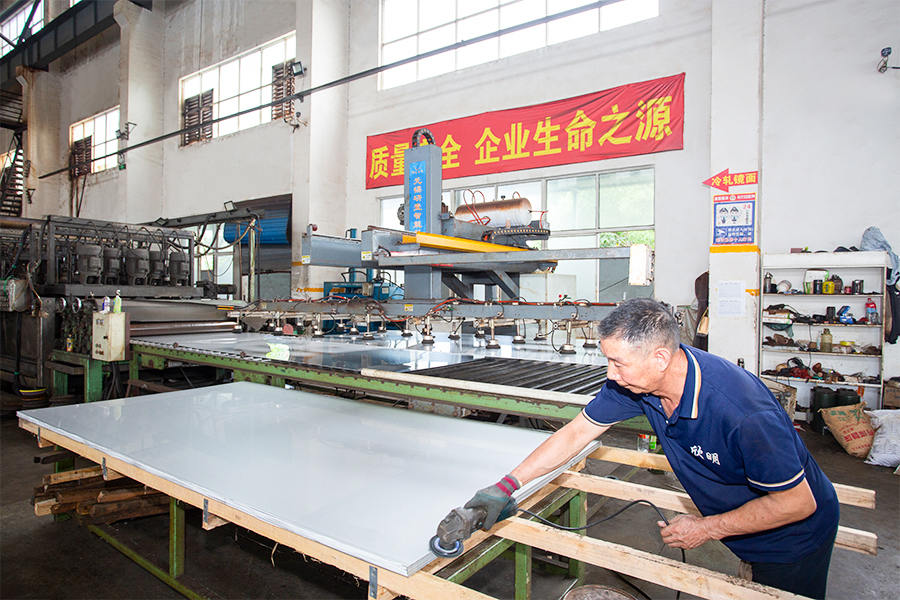
Stainless steel plates are flat-rolled steel products with a thickness generally starting at 3mm and extending beyond 100mm for heavy industrial applications, distinguishing them from stainless steel sheets, which are thinner, and coils, which are the wound form of thinner-gauge material. The defining characteristic of all stainless steel — regardless of form — is its chromium content of at least 10.5% by weight, which enables the formation of a self-repairing passive oxide layer on the surface that provides corrosion resistance. Plates are produced through hot rolling, and may subsequently undergo cold rolling, annealing, and surface finishing to achieve the required mechanical properties and surface condition.
Stainless steel plates are fundamental structural and functional materials in industries ranging from petrochemical processing and power generation to food manufacturing, marine engineering, and architectural construction. The selection of the appropriate grade, thickness, and surface finish requires an understanding of the mechanical demands, corrosive environment, temperature exposure, and fabrication requirements specific to each application.
Major Stainless Steel Grades Used in Plate Form
Stainless steel is not a single material but a family of alloys, each engineered for specific performance characteristics. For plate applications, several grades dominate industrial procurement, and understanding their differences is essential to making the right material selection.
Grade 304 and 304L
Grade 304 is the most widely used stainless steel in the world, accounting for the majority of all stainless steel plate consumption globally. It contains approximately 18% chromium and 8% nickel, which gives it excellent corrosion resistance in a wide range of environments, good formability, and strong weldability. The low-carbon variant, 304L, limits carbon content to 0.03% maximum, reducing the risk of sensitization — chromium carbide precipitation at grain boundaries — during welding, which can compromise corrosion resistance in the heat-affected zone. 304L is specified when plate sections will undergo extensive welding without post-weld annealing.
Grade 316 and 316L
Grade 316 adds 2–3% molybdenum to the base 18/8 chromium-nickel composition, significantly improving resistance to chloride-induced pitting and crevice corrosion. This makes 316 the preferred grade for marine environments, coastal infrastructure, chemical processing equipment, and pharmaceutical manufacturing where chloride exposure is a constant concern. As with 304L, the 316L variant offers lower carbon content for improved post-weld corrosion resistance, and is the more commonly specified of the two in heavy fabrication work.
Grade 321 and 347
These are stabilized austenitic grades designed for sustained high-temperature service. Grade 321 incorporates titanium, and grade 347 incorporates niobium (columbium), both of which preferentially combine with carbon to prevent sensitization during prolonged exposure to temperatures between 425°C and 850°C. These grades are used in exhaust systems, heat exchangers, furnace components, and aircraft engine parts where both elevated temperature strength and oxidation resistance are required alongside corrosion resistance.
Duplex Grades: 2205 and 2507
Duplex stainless steels have a two-phase microstructure of roughly equal proportions of austenite and ferrite, which gives them approximately twice the yield strength of standard austenitic grades while maintaining excellent resistance to stress corrosion cracking — a failure mode to which standard 304 and 316 are susceptible under combined tensile stress and chloride exposure. Grade 2205 (UNS S32205) is the workhorse duplex grade, used extensively in oil and gas pipelines, pressure vessels, and desalination plant components. Super duplex 2507 offers even higher corrosion resistance and strength for the most aggressive offshore and chemical processing environments.
Ferritic and Martensitic Grades
Ferritic grades such as 430 offer moderate corrosion resistance at lower cost than austenitic grades, with good resistance to stress corrosion cracking, and are used in automotive trim, heat exchangers, and architectural applications with moderate environmental exposure. Martensitic grades such as 410 and 420 prioritize hardness and wear resistance over corrosion resistance, and are used in cutlery, valve components, and wear plates where surface hardness is the primary requirement.
Standard Thickness Ranges and Dimensional Specifications
Stainless steel plates are produced and stocked across a broad range of thicknesses and plan dimensions. Standard mill plate dimensions vary by producing country and specification standard, but the following ranges represent the most commonly traded sizes in global industrial markets.
| Thickness Range | Classification | Typical Applications |
| 3mm – 6mm | Light plate | Cladding, tank liners, food equipment panels |
| 6mm – 20mm | Medium plate | Pressure vessels, structural frames, chemical tanks |
| 20mm – 60mm | Heavy plate | Offshore platforms, heat exchangers, reactor vessels |
| 60mm – 150mm+ | Extra heavy / quarto plate | Nuclear components, heavy machinery, tooling blocks |
Standard plan dimensions for hot-rolled stainless steel plate commonly include 1500mm × 3000mm, 1500mm × 6000mm, 2000mm × 4000mm, and 2000mm × 6000mm, though mill-direct orders can often accommodate custom widths and lengths for large project requirements. Thickness tolerances are governed by standards such as ASTM A480, EN 10029, or JIS G4304, and should be confirmed in purchase specifications to ensure fabrication compatibility.
Surface Finishes and Their Practical Significance
The surface finish of a stainless steel plate affects not only its visual appearance but also its corrosion resistance, cleanability, friction characteristics, and suitability for further processing. Specifying the correct finish is particularly critical in food, pharmaceutical, and architectural applications.
- No. 1 (Hot Rolled, Annealed, Pickled): The standard mill finish for hot-rolled plate. The surface is rough, dull, and slightly scaled, with all mill oxide removed by acid pickling. This finish is used as-supplied for most industrial structural and pressure vessel applications where appearance is not a concern.
- No. 2B: A smooth, moderately reflective finish achieved by cold rolling, annealing, and light skin-pass rolling. Common in thinner plate and sheet applications where a cleaner surface is needed for subsequent polishing or coating.
- No. 2D: Similar to 2B but with a more matte, non-reflective surface. Often specified for deep drawing applications as its texture helps retain lubricants during forming.
- No. 4 (Brushed / Satin): A unidirectional brushed finish produced by abrasive belt polishing to approximately 150 grit. Widely used in food processing equipment, commercial kitchen surfaces, and architectural elements. The fine parallel lines hide minor scratches and are easy to clean.
- No. 8 (Mirror): A highly reflective, mirror-like finish produced through sequential polishing stages. Used in decorative architectural panels, lift interiors, and precision optical components. More susceptible to visible scratching than brushed finishes.
- Bead Blasted: A uniform matte finish produced by blasting the surface with glass or ceramic beads. Provides a consistent non-directional texture that is resistant to showing fingerprints, commonly specified for architectural and consumer product applications.
Key Industries and Applications for Stainless Steel Plates
The versatility of stainless steel plate — spanning multiple grades, finishes, and thicknesses — makes it an indispensable material across a remarkably diverse set of industries. Each sector places different demands on the material, which drives the differentiation in grade and specification selection.
Oil, Gas, and Petrochemical Processing
Pressure vessels, reactors, heat exchanger shells, and pipeline components in petrochemical plants frequently require stainless steel plate in grades 316L, 321, or duplex 2205. These environments combine high pressure, elevated temperature, and exposure to hydrogen sulfide, chlorides, and aggressive process chemicals that would rapidly corrode carbon steel alternatives. Plates in these applications must meet stringent impact toughness requirements at low temperatures and comply with pressure vessel codes such as ASME Section VIII or PED in Europe.
Food, Beverage, and Pharmaceutical Manufacturing
Hygienic industries require materials that resist corrosion from food acids, cleaning chemicals, and sterilization cycles while presenting surfaces that can be thoroughly cleaned and do not harbor bacteria. Grade 304 is the standard choice for most food processing equipment surfaces, with 316L specified where chloride-based sanitizers or saline food products are involved. Surface finish requirements are typically No. 4 minimum, with 2B or electropolished finishes specified for direct product contact surfaces in pharmaceutical applications where surface roughness standards (Ra values) are formally defined.
Architecture, Construction, and Infrastructure
Stainless steel plate is used in structural connections, bridge components, tunnel linings, coastal building cladding, and landmark architectural facades. Grade 316 or 316L is strongly preferred for exterior applications in coastal or urban polluted environments. Architectural projects often specify custom surface finishes — including colored PVD coatings applied over polished stainless — to achieve specific aesthetic effects while retaining the material's durability and corrosion resistance.
Marine and Offshore Engineering
Marine applications demand exceptional resistance to seawater, salt spray, and biofouling. Super duplex 2507 and 6Mo austenitic grades are frequently used for subsea components, heat exchanger tube sheets, and offshore platform structural connections where standard 316L would be insufficient. The high strength of duplex grades also allows for reduced plate thickness compared to austenitic alternatives, providing weight savings in weight-critical offshore structures.
Critical Factors When Sourcing Stainless Steel Plates
Purchasing stainless steel plate involves evaluating multiple factors beyond price per kilogram. Material traceability, test certification, and supply chain reliability are particularly important given the safety-critical nature of many plate applications.
- Mill Test Certificates (MTC): Always require EN 10204 3.1 or 3.2 certified test reports confirming chemical composition and mechanical properties for each plate or heat lot. For pressure vessel applications, 3.2 certification — verified by an independent third-party inspector — is typically mandated.
- Heat and lot traceability: Each plate should carry a heat number traceable back to the original melt record, enabling full material genealogy in the event of quality investigations or regulatory audits.
- Ultrasonic testing (UT): For heavy plates used in pressure vessels or critical structural applications, specify ultrasonic testing to ASTM A578 or EN 10160 to detect internal laminations, inclusions, or segregation that could compromise structural integrity.
- Origin and trade compliance: With stainless steel subject to anti-dumping duties in many markets, confirming the country of melt and manufacture is essential to avoid unexpected import duty liabilities. Request country of origin documentation and verify compliance with applicable trade regulations.
- Flatness and straightness tolerances: Heavy plate used in precision fabrication must meet flatness tolerances specified in the applicable standard. Plates outside tolerance create fit-up problems in welded assemblies and may require costly straightening operations before use.
Working with established mill-direct suppliers or reputable stockholding service centers that maintain documented quality management systems — ideally ISO 9001 certified — significantly reduces the risk of receiving non-conforming or misidentified material. For high-value or safety-critical applications, independent inspection of material at the source before shipment provides an additional layer of assurance that the plates supplied match the ordered specification in every measurable parameter.