

 English
 русский
 عربى
عربى 中文简体
中文简体
Content
- 1 What Makes Stainless Steel Welded Pipe Different From Other Pipe Types?
- 2 Which Grades of Stainless Steel Are Most Commonly Used in Welded Pipe?
- 3 How Is Stainless Steel Welded Pipe Manufactured and What Standards Apply?
- 4 Where Is Stainless Steel Welded Pipe Most Widely Used?
- 5 What Should Buyers Look for When Sourcing Stainless Steel Welded Pipe?
- 6 How Does Stainless Steel Welded Pipe Compare to Seamless Pipe in Real-World Use?
- 7 Practical Tips for Welding and Fabricating Stainless Steel Welded Pipe
What Makes Stainless Steel Welded Pipe Different From Other Pipe Types?
Stainless steel welded pipe is manufactured by forming flat-rolled stainless steel strip or plate into a cylindrical shape and then joining the edges using a welding process, most commonly TIG (Tungsten Inert Gas) or plasma welding. Unlike seamless pipe, which is extruded from a solid billet, welded pipe begins as a flat material, which gives manufacturers more control over wall thickness, surface finish, and dimensional consistency. This fundamental difference in production method directly influences cost, availability, and suitability for various applications.
The defining characteristic of stainless steel welded pipe is the visible or concealed weld seam running along the pipe's length. Modern manufacturing techniques have significantly improved weld quality to the point where properly produced welded pipe can match or closely approach the mechanical performance of seamless alternatives in many non-critical applications. For industries that demand hygiene, corrosion resistance, and aesthetic appearance, stainless steel welded pipe has become the preferred choice over carbon steel or aluminum pipe systems.
Which Grades of Stainless Steel Are Most Commonly Used in Welded Pipe?
Not all stainless steel grades perform equally in welded pipe applications. The choice of grade depends on the working environment, temperature range, exposure to chemicals, and budget. Below are the most widely used grades:
| Grade | Key Properties | Typical Applications |
| 304 / 304L | Good corrosion resistance, versatile, cost-effective | Food processing, architecture, general plumbing |
| 316 / 316L | Superior chloride resistance due to molybdenum content | Marine, pharmaceutical, chemical processing |
| 321 | Titanium-stabilized, resists sensitization at high temps | Exhaust systems, high-temperature equipment |
| 2205 Duplex | High strength, excellent stress corrosion cracking resistance | Oil and gas, desalination plants |
Grade 304 remains the most widely specified due to its balance of corrosion resistance, formability, and affordability. Grade 316L, with its low carbon content, is preferred when post-weld heat treatment is not feasible or when the pipe will be exposed to chloride-rich environments. Duplex grades like 2205 are increasingly adopted in aggressive industrial environments where both strength and corrosion resistance are critical.
How Is Stainless Steel Welded Pipe Manufactured and What Standards Apply?
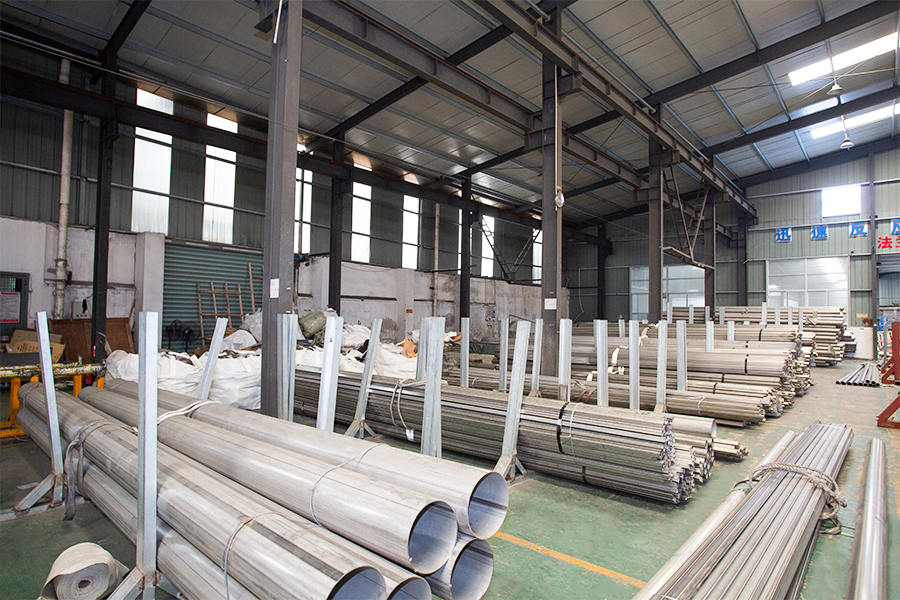
The production of stainless steel welded pipe follows a precise sequence of operations to ensure dimensional accuracy, weld integrity, and surface quality. Understanding the process helps buyers evaluate supplier capabilities and product consistency.
The Manufacturing Process
- Coil slitting: Stainless steel coils are slit to the precise width required for the target pipe diameter and wall thickness.
- Roll forming: The strip is passed through a series of roller dies that progressively shape it into a tubular form.
- Welding: The open seam is welded using high-frequency induction (HFI) or TIG welding, depending on the application's demands.
- Bead removal: The internal weld bead is often removed for sanitary or flow-efficiency applications, particularly in food and beverage industries.
- Annealing and pickling: Heat treatment relieves welding stress, while pickling removes surface oxides and restores corrosion resistance.
- Non-destructive testing (NDT): Eddy current or hydrostatic testing verifies weld integrity before dispatch.
Applicable Industry Standards
Stainless steel welded pipe is produced and tested against internationally recognized standards. Common references include ASTM A312 for austenitic grades used in high-temperature and general corrosive service, ASTM A270 for sanitary tubing used in food and dairy applications, EN 10217-7 for European pressure pipe applications, and ASME B36.19M for dimensional tolerances. Compliance with these standards ensures that the pipe meets minimum requirements for chemical composition, mechanical properties, dimensional accuracy, and weld quality.
Where Is Stainless Steel Welded Pipe Most Widely Used?
The versatility of stainless steel welded pipe means it appears across a broad spectrum of industries. Its combination of corrosion resistance, hygienic surface properties, and mechanical strength makes it a reliable solution in environments where failure would carry significant consequences.
Food, Beverage, and Pharmaceutical Industries
These sectors demand pipe systems that resist contamination, are easy to clean, and comply with strict hygiene regulations. Stainless steel welded pipe, particularly in Grade 316L with a polished internal bore, is used extensively for transporting liquids, slurries, and gases in breweries, dairy plants, pharmaceutical production lines, and beverage bottling facilities. The smooth internal surface prevents bacterial adhesion and simplifies CIP (clean-in-place) processes.
Construction and Architectural Applications
Stainless steel welded pipe is widely specified in structural and decorative applications including handrails, balustrades, curtain wall supports, and interior design features. Its aesthetic appeal, available in mirror, satin, and brushed finishes, combined with long-term durability in outdoor environments, makes it a cost-effective architectural choice over the full lifecycle of a building.
Oil, Gas, and Petrochemical Sectors
While seamless pipe is often mandated for high-pressure critical service, stainless steel welded pipe is used extensively in process plant pipework, instrumentation lines, heat exchanger shells, and offshore topside structures where corrosion from saline or acidic environments is a primary concern. Duplex and super duplex grades are increasingly used in subsea flowlines and injection systems.
Water Treatment and Desalination
Municipal water treatment plants and desalination facilities rely heavily on stainless steel welded pipe for membrane housings, distribution headers, and chemical dosing lines. The resistance of Grade 316 and duplex alloys to chloride-induced pitting corrosion is particularly valuable in these high-salinity environments.
What Should Buyers Look for When Sourcing Stainless Steel Welded Pipe?
Purchasing stainless steel welded pipe involves more than comparing price per meter. Several technical and commercial factors directly affect long-term performance and total cost of ownership.
- Material certification: Always request mill test certificates (MTCs) compliant with EN 10204 3.1 or 3.2. These documents confirm actual chemical composition and mechanical test results for the specific batch supplied.
- Weld quality documentation: For pressure applications, ask for hydrostatic test records or eddy current test results. Weld radiography or ultrasonic testing reports may be required for critical service.
- Dimensional tolerances: Confirm that outside diameter, wall thickness, straightness, and ovality comply with the referenced standard. Loose tolerances increase installation difficulty and may compromise joint integrity.
- Surface finish specification: Define the required finish (e.g., 2B, No.4, electropolished, or mirror) before ordering, as post-delivery finishing is costly and may not be feasible on assembled systems.
- Heat number traceability: For regulated industries, full traceability from raw coil to finished pipe is essential for audit compliance and incident investigation.
Working with established distributors or mills that hold ISO 9001 certification reduces procurement risk and ensures consistent quality across repeat orders. Requesting sample pieces or reference projects from the supplier is a practical step when qualifying a new source.
How Does Stainless Steel Welded Pipe Compare to Seamless Pipe in Real-World Use?
The seamless vs. welded debate is often oversimplified. In practice, the right choice depends on operating conditions, code requirements, and budget constraints. Stainless steel welded pipe offers several practical advantages: it is generally 20–40% less expensive than seamless pipe in equivalent sizes and grades, it is more readily available in a wider range of sizes and wall thicknesses, and it tends to offer tighter dimensional tolerances due to the controlled nature of the flat-roll forming process.
Seamless pipe retains advantages in very high-pressure service, elevated-temperature applications above 500°C, and in some pressure vessel codes that explicitly require seamless construction. However, for the vast majority of industrial, commercial, and sanitary applications, modern stainless steel welded pipe manufactured to recognized standards performs equivalently and offers a lower installed cost. Engineers and procurement teams should evaluate both options based on their specific design codes and service conditions rather than defaulting to seamless pipe as a blanket conservative choice.
Practical Tips for Welding and Fabricating Stainless Steel Welded Pipe
Field fabrication and installation of stainless steel welded pipe requires attention to several factors that differ from working with carbon steel. Following best practices protects the material's corrosion resistance and ensures weld integrity throughout the system's service life.
- Use dedicated stainless steel tools: Never use grinding wheels, wire brushes, or cutting discs that have been used on carbon steel. Embedded iron particles cause surface rust contamination.
- Apply back purging during welding: For austenitic stainless steel, purging the pipe interior with argon during TIG welding prevents oxidation of the root pass and maintains corrosion resistance at the weld zone.
- Control heat input: Excessive heat causes sensitization in standard grades, depleting chromium at grain boundaries and reducing corrosion resistance. Use low-carbon grades (304L, 316L) or titanium-stabilized grades (321) where welding heat is unavoidable.
- Passivate after fabrication: Cleaning the fabricated assembly with a citric acid or nitric acid passivation solution restores the passive chromium oxide layer damaged during cutting and welding.
- Support and alignment: Stainless steel has a higher coefficient of thermal expansion than carbon steel. Pipe support spacing and expansion loop design must account for greater movement to prevent stress concentrations at welds.
Attention to these details during fabrication substantially extends the operational lifespan of stainless steel welded pipe systems and minimizes the risk of premature corrosion failures that can be both costly and difficult to remediate once a system is commissioned.