

 English
 русский
 عربى
عربى 中文简体
中文简体
Content
- 1 Why 304 Is the Default Grade for Pipe Fittings
- 2 Types of 304 Stainless Steel Pipe Fittings
- 3 Elbows and Bends: The Workhorses of Direction Change
- 4 Flanges and Bolted Connections in 304 Service
- 5 Standards and Specifications You Should Confirm
- 6 How to Choose the Right Fitting for Your Line
- 7 Typical Applications Across Industries
- 8 From Stock Material to Custom Fabricated Fittings
- 9 Installation and Maintenance Notes
Pipe fittings are the parts nobody notices until something leaks. A 90-degree elbow, a flange pair, a reducing tee, a threaded coupling: each one has to carry the same pressure, the same temperature and the same aggressive media as the pipe it joins, often for decades on end. That is exactly why 304 stainless steel pipe fittings have become such a familiar choice in chemical plants, food factories, water treatment lines and powder handling systems around the world.
At Wuxi Chengfeng Metal Technology, we have supplied stainless steel and nickel-based alloy materials, along with fabricated components, to manufacturers, engineering contractors and large industrial buyers for many years. In this guide, we share what we have learned on the shop floor and in the warehouse about 304 fittings: what the material can and cannot do, which forms are available, how the relevant standards work, and how to keep a piping system reliable over its full service life.
Why 304 Is the Default Grade for Pipe Fittings
Type 304 is an austenitic stainless steel built around roughly 18% chromium and 8% nickel, which is why it is still widely called 18-8 stainless. The chromium reacts with oxygen to form a thin, self-repairing passive layer on the surface. As long as that layer is intact, the steel resists rust in atmospheric conditions, fresh water, many organic chemicals, and a broad range of food and beverage media.
The material stays tough and ductile from cryogenic temperatures up to around 800 degrees Celsius in continuous service, and it is essentially non-magnetic in the annealed condition, although cold working such as bending or thread rolling will make it slightly magnetic. It is not the right answer everywhere. In chloride-rich environments, hot concentrated caustic solutions or strongly reducing acids, pitting and stress corrosion cracking become real risks, and a molybdenum-bearing grade such as 316 is usually the safer engineering choice.
For welded assemblies, the low-carbon variant 304L is often specified because its carbon content of 0.03% or less reduces the risk of chromium carbide precipitation in the heat-affected zone, which in turn protects intergranular corrosion resistance. Many fitting specifications therefore accept dual-certified WP304/304L material.
| Grade | Carbon Content | Key Characteristic | Typical Fit |
|---|---|---|---|
| 304 | Max 0.08% | General corrosion resistance, good strength | Water, food, general chemical service |
| 304L | Max 0.03% | Improved weldability, less carbide precipitation | Heavy welded piping, thin-wall systems |
| 316 / 316L | Max 0.08% / 0.03% | Molybdenum added for chloride resistance | Marine, coastal, brine and chloride lines |
Types of 304 Stainless Steel Pipe Fittings
The catalogue of fittings is broad, but most industrial piping systems are assembled from a fairly small family of shapes. Understanding what each shape does is the first step toward specifying the right combination.
- Elbows and bends in 45 and 90 degrees change the direction of flow, with long-radius versions keeping pressure drop lower.
- Tees and crosses create branches, either equal or reducing.
- Reducers and eccentric reducers step the line diameter up or down.
- Couplings, unions and nipples join straight runs or extend threaded connections.
- Caps and plugs close off a line end or a future connection point.
- Flanges allow bolted connections to pumps, valves, vessels and instruments.
- Stub ends support lap joint flanges where frequent dismantling is expected.
| Fitting | Function | Typical Service |
|---|---|---|
| Elbow | Change flow direction | Skid piping, process lines, utilities |
| Tee | Create a branch | Manifolds, distribution headers |
| Reducer | Change line size | Pump suction, control valve stations |
| Coupling | Join two pipe ends | Small bore and instrument tubing |
| Flange | Bolted connection | Equipment nozzles, maintenance points |
| Cap or plug | Close an opening | Spare branches, hydrotest points |
Fittings are also grouped by connection method. Butt-weld fittings give the strongest, most leak-tight joints and dominate larger process piping. Socket-weld fittings suit small bore lines under two inches. Threaded fittings remain convenient where welding is impractical, though the thread root becomes a natural crevice for corrosion and must be sealed carefully.
If you would like a wider look at how these parts slot into a complete system, our overview article on stainless steel pipe fittings and pipe connection solutions covers the topic from a system design point of view.
Elbows and Bends: The Workhorses of Direction Change
Elbows take the most punishment in any piping layout, because flow turbulence, erosion and pressure drop all concentrate at the turning point. A 304 stainless steel elbow in a long-radius configuration distributes that turbulence over a longer arc, which reduces both noise and wear on the downstream wall.
For abrasive slurries or high-velocity powder conveying, many of our customers prefer thicker schedules or custom-formed bends rather than standard wall thickness. Whether you need a short-radius elbow for a cramped skid or a large-diameter bend for a conveying line, matching the radius and wall thickness to the duty is far more important than simply ordering the cheapest shape available in the catalogue.
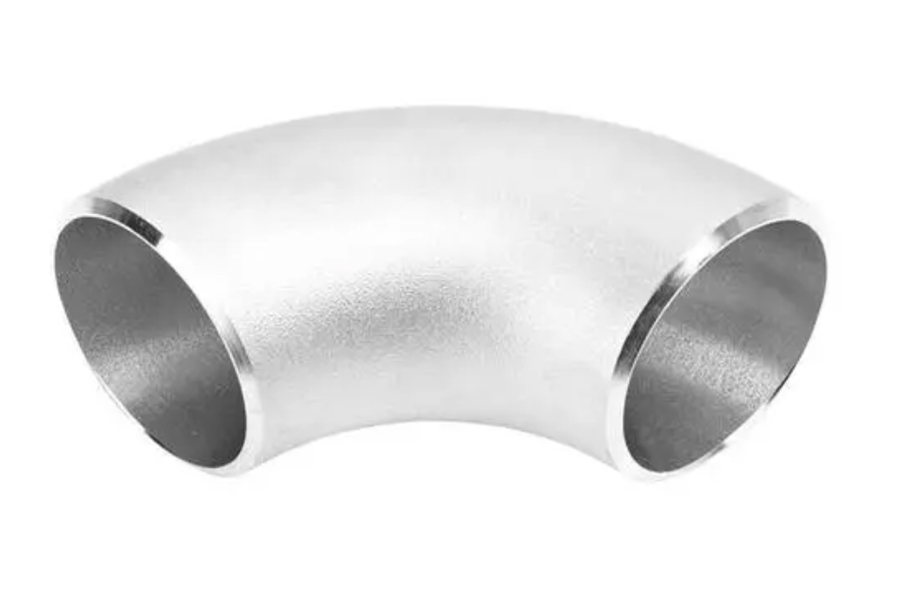 Stainless Steel Elbow ManufacturersStainless Steel ElbowView Product →
Wall thickness selection is guided by the pipe schedule. Schedule 10S and 40S cover most light and general service duties, while Schedule 80S and heavier walls are used where erosion, external loading or higher pressure ratings demand more material. Always confirm that the elbow schedule matches the adjoining pipe, otherwise the weld joint becomes a mismatch that inspectors will flag.
Flanges and Bolted Connections in 304 Service
Flanges are where a piping system meets the rest of the plant: pump casings, vessel nozzles, valves, filters and instruments. A 304 stainless steel flange must therefore satisfy two demands at once, pressure containment and a repeatable seal after repeated dismantling for maintenance.
Weld neck flanges are the standard choice for high-pressure and cyclic service because the tapered hub spreads stress into the pipe. Slip-on flanges are economical for lower-pressure utilities. Blind flanges close nozzles and provide access points, while lap joint flanges paired with stub ends let the bolt holes be rotated to align without turning the pipe itself. Gasket selection matters just as much as the flange face: spiral wound gaskets with a stainless outer ring are common in process service, while sanitary applications often use elastomeric seals in tri-clamp arrangements.
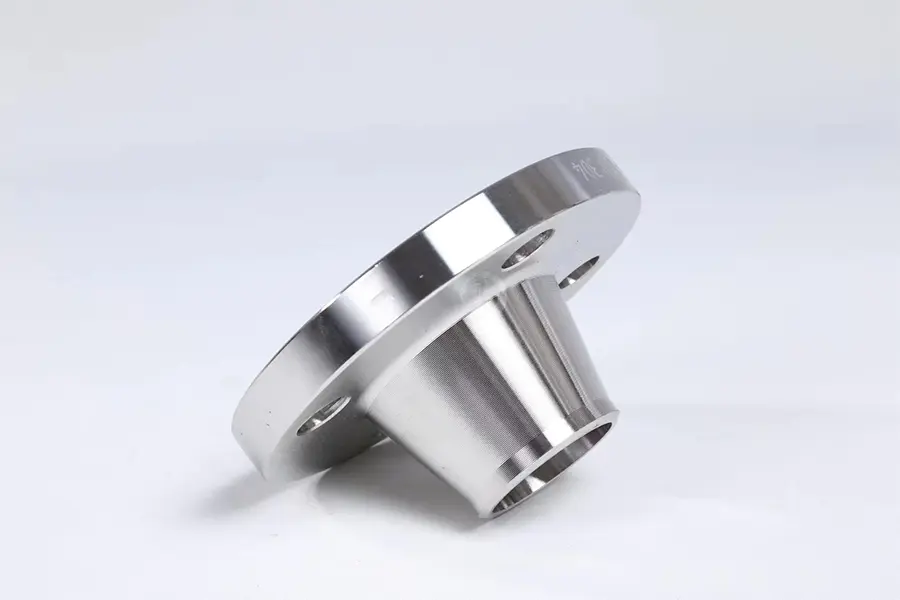 Stainless Steel Flange ManufacturersStainless Steel FlangeView Product →
Bolt tightening should follow a star pattern in multiple passes to avoid uneven gasket compression. On stainless flanges, use anti-seize compound on the threads and consider hardened washers, since stainless-on-stainless threads gall easily under high torque.
Standards and Specifications You Should Confirm
Fitting standards vary by market, and mixing them without checking dimensions is a common source of rework. In North American practice, butt-weld fittings are typically supplied to ASME B16.9 and ASTM A403, forged threaded and socket-weld fittings to ASME B16.11 and ASTM A182, and flanges to ASME B16.5 for sizes up to 24 inches. European projects commonly reference EN 10253 or DIN 2605, 2615 and 2616, while Japanese work follows JIS B2312 and JIS B2313.
Beyond dimensions, ask for the material certificate. An EN 10204 3.1 certificate ties the heat number to the chemical composition and mechanical test results, which lets your quality team verify that the delivered fittings truly match the specified grade rather than a substituted one.
How to Choose the Right Fitting for Your Line
Selection is rarely about a single variable. Working through a short checklist prevents most installation surprises.
- Define the media, including concentration, chloride level and whether flow is continuous or intermittent.
- Confirm design temperature and pressure, then add the appropriate safety margin.
- Decide on the grade, remembering that 304L improves weldability while 316 handles chlorides better.
- Pick the connection type based on size, accessibility and inspection requirements.
- Match the schedule and wall thickness to the adjoining pipe.
- Verify the applicable standard, face type, pressure class and certification.
- Check lead time and stock availability before finalizing the bill of materials.
Typical Applications Across Industries
In food and beverage plants, 304 fittings are used for product lines, cleaning-in-place circuits and utility water because the surface is easy to clean and does not impart taste. In chemical and pharmaceutical facilities, they carry solvents, acids and process intermediates where general corrosion resistance is sufficient. Water treatment and desalination pre-treatment lines, shipbuilding exhaust and ballast systems, and general factory utilities all rely on the same family of components.
Powder and bulk solids handling is another area where 304 fittings play a quiet but critical role, connecting pneumatic conveying lines, cyclone separators, sifters and mobile silos. In these systems, abrasion resistance and smooth internal geometry matter more than pressure rating, and custom fabrication often replaces off-the-shelf parts entirely.
From Stock Material to Custom Fabricated Fittings
Because our warehouse holds around 20,000 tons of stainless steel coils in addition to plate, pipe and profiles, we can often move from a drawing to a finished component without waiting on an external mill. That stock position shortens lead times for both standard fittings and one-off fabrications.
Our technical team reads customer drawings and translates design intent into practical manufacturing steps, while experienced welders and fitters handle assembly and our inspection staff check each item before dispatch. Typical custom work includes formed bends, large-diameter welded pipe, half-pipe headers, jacketed flanges, equipment shells, mixing vessels, filtration components and complete powder conveying pipe spools. If you want to see how this is organized, you can review our manufacturing technology and quality control workflow.
Installation and Maintenance Notes
Good components still fail when they are installed carelessly. Align pipe ends before welding to avoid forcing the joint, purge the inside of the line with argon when welding stainless butt joints so the root does not oxidize, and passivate or pickle weld areas where required to restore the passive layer. Keep carbon steel tools and grinding wheels away from stainless surfaces to prevent iron contamination, which shows up later as surface rust.
Once in service, 304 piping generally needs very little attention. Periodic inspection of flanged joints, supports and any area exposed to chlorides or stagnant liquid is usually enough. Where a line is shut down for long periods, draining or flushing it prevents crevice corrosion from developing under deposits.
Choosing 304 stainless steel pipe fittings is rarely the most glamorous engineering decision on a project, but it is one of the most consequential. The right grade, the right shape, the right standard and the right wall thickness add up to a system that quietly does its job for years, while a shortcut in any of those areas tends to announce itself at the worst possible moment.
If you are preparing a bill of materials, comparing standards, or need custom fabricated fittings and pipe spools built to your drawings, our team is glad to review your requirements and recommend a practical configuration. Send us your specifications, and we will respond with material options, dimensions and delivery information.