

 English
 русский
 عربى
عربى 中文简体
中文简体
Content
304 stainless steel seamless pipe is one of the most widely specified materials in industrial piping systems, valued for its combination of corrosion resistance, mechanical strength, and manufacturing consistency. Unlike welded pipe, seamless construction eliminates the weld seam entirely, producing a more uniform structure that performs better under pressure and in corrosive environments. This article covers how 304 seamless pipe is manufactured, its key properties, and what factors matter most when specifying it for a project.
What Makes 304 Stainless Steel Suitable for Piping
Grade 304 is an austenitic stainless steel containing approximately 18 percent chromium and 8 percent nickel, a composition that gives it strong resistance to oxidation and general corrosion across a wide range of environments. The chromium content forms a passive oxide layer on the metal's surface that continuously protects the underlying steel from rust and chemical attack, while the nickel content contributes to the alloy's ductility and helps stabilize its austenitic crystal structure, which is what gives 304 stainless steel its excellent formability and toughness even at low temperatures.
This combination of properties makes 304 stainless steel well suited to piping applications across food processing, pharmaceutical manufacturing, chemical handling, and general industrial fluid transport, where both hygiene and long-term durability are priorities. While more specialized grades exist for extreme chemical exposure, 304 remains the standard choice for the large majority of general-purpose stainless piping needs due to its balance of performance and cost.
How Seamless Pipe Is Manufactured
Seamless pipe production begins with a solid, cylindrical billet of 304 stainless steel, which is heated to a high temperature to make it malleable enough for shaping. This heated billet is then pierced through its center using a piercing mandrel, a process that hollows out the solid cylinder to create a rough, thick-walled tube shape. This is typically achieved through a rotary piercing process, where the billet is rotated and forced over a piercing point, gradually forming the initial hollow shell.
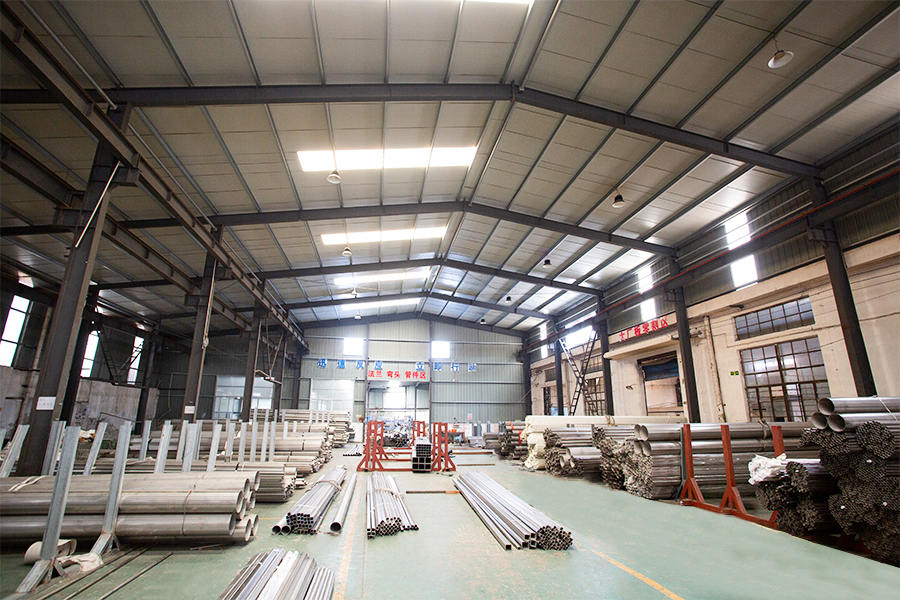
Once the initial hollow shell is formed, it goes through a series of rolling and drawing operations that reduce its wall thickness and diameter to the precise final specifications, while also improving the surface finish and dimensional accuracy of the pipe. Because this entire process forms the pipe from a single piece of solid metal without any welding, the resulting seamless pipe has no weld seam, which eliminates a common point of structural weakness found in welded pipe alternatives.
Key Manufacturing Stages
- Heating the solid stainless steel billet to forming temperature
- Rotary piercing to create the initial hollow tube shell
- Hot rolling to reduce wall thickness and extend length
- Cold drawing or rolling for precise final dimensions and finish
- Heat treatment and surface finishing to meet final specifications
Seamless vs Welded Pipe: Key Differences
Understanding the difference between seamless and welded pipe helps clarify why seamless construction is often specified for higher-pressure or more critical applications. Welded pipe is formed by rolling a flat sheet of steel into a cylindrical shape and then welding the seam along its length, which introduces a heat-affected zone where the material's crystal structure and mechanical properties differ slightly from the surrounding metal. This weld seam can become a point of weakness, particularly in high-pressure or cyclic loading applications, where stress concentrations at the seam may lead to premature failure.
Seamless pipe avoids this concern entirely, offering a more uniform strength profile around its entire circumference. This makes seamless pipe the preferred choice for high-pressure systems, critical process piping, and applications where failure could pose significant safety or contamination risks.
| Factor | Seamless Pipe | Welded Pipe |
| Structural uniformity | Consistent throughout | Weld seam is a distinct zone |
| Pressure rating | Generally higher | Lower due to seam weakness |
| Cost | Higher | Lower |
| Best suited for | High-pressure, critical systems | General, low-to-medium pressure use |
Common Applications of 304 Seamless Pipe
Food and beverage processing facilities widely use 304 seamless pipe for transporting liquids and products through production lines, since its smooth interior surface and corrosion resistance help maintain hygienic conditions while resisting bacterial buildup. Pharmaceutical manufacturing similarly relies on 304 seamless pipe for its ability to withstand repeated sterilization processes without degrading, an essential requirement for equipment that must meet strict regulatory cleanliness standards.
Chemical processing plants use 304 seamless pipe extensively for handling a variety of fluids, though it is worth noting that highly aggressive chemicals, particularly those containing chlorides, may require the more corrosion-resistant 316 grade instead. General industrial and mechanical applications, including instrumentation lines, heat exchangers, and structural framework, also frequently specify 304 seamless pipe for its reliable strength and long service life under normal operating conditions.
Typical Industries and Uses
- Food and beverage processing lines
- Pharmaceutical and biotech manufacturing equipment
- Chemical processing and fluid transport systems
- Instrumentation and heat exchanger tubing
- Structural and architectural applications requiring corrosion resistance
Key Specifications to Check When Sourcing
When specifying 304 seamless pipe for a project, several dimensional and material properties should be confirmed against relevant industry standards. Outside diameter and wall thickness, typically specified according to schedule ratings such as Schedule 10, 40, or 80, determine the pipe's pressure-handling capacity and should be selected based on the operating pressure and flow rate requirements of the system. Standards such as ASTM A312 govern the chemical composition, mechanical properties, and dimensional tolerances required for seamless stainless steel pipe used in pressure applications.
Surface finish requirements also vary by application, with sanitary applications like food and pharmaceutical processing often requiring an electropolished or mirror-polished interior surface to minimize bacterial adhesion and ease of cleaning, while general industrial applications may only require a standard mill finish. Requesting mill test certificates from suppliers provides documented verification of the pipe's chemical composition and mechanical properties, which is particularly important for projects subject to regulatory inspection or certification requirements.
Specification Checklist
- Confirm outside diameter and wall thickness against pressure requirements
- Verify compliance with relevant standards such as ASTM A312
- Specify surface finish appropriate to the application (mill, polished, electropolished)
- Request mill test certificates for chemical and mechanical verification
- Confirm compatibility with the specific fluids or chemicals being transported
304 stainless steel seamless pipe remains a dependable choice for industries that demand corrosion resistance, structural uniformity, and long-term reliability in their piping systems. By understanding how seamless construction differs from welded alternatives and carefully verifying dimensional and material specifications during sourcing, engineers and procurement teams can select pipe that performs safely and consistently throughout its intended service life.