

 English
 русский
 عربى
عربى 中文简体
中文简体
Content
- 1 Chemical Composition and What It Means for Performance
- 2 Mechanical Properties of 301 Hot-Rolled Coil in Annealed Condition
- 3 Work-Hardening Behavior: The Defining Characteristic of Grade 301
- 4 Hot-Rolled Coil Production Process and Surface Condition
- 5 Corrosion Resistance: Where 301 Performs and Where It Faces Limitations
- 6 Key Industries and Applications That Specify 301 Hot-Rolled Coil
- 7 Specification and Procurement Checklist for 301 Hot-Rolled Coil
Among the austenitic stainless steel grades used in high-volume industrial and manufacturing applications, 301 stainless steel hot-rolled coil holds a distinctive position. It offers a combination of high strength potential through cold working, good corrosion resistance, and excellent formability that makes it a preferred starting material for a broad range of demanding fabrication processes. Whether you are sourcing coil for springmaking, structural components, transportation equipment, or precision stamped parts, understanding the metallurgical characteristics, mechanical behavior, and processing requirements of 301 hot-rolled coil is essential for making sound procurement decisions and achieving the performance results your application demands.
Chemical Composition and What It Means for Performance
Grade 301 is an austenitic stainless steel in the 300 series, sharing its basic iron-chromium-nickel structure with the more widely used 304 grade but differentiated by its lower chromium and nickel content. These compositional differences are deliberate engineering choices that give 301 a specific performance profile suited to applications where work-hardening behavior is the primary design lever.
The standard chemical composition of 301 stainless steel is defined by ASTM A666, EN 10088, and equivalent national standards. The key elements and their typical ranges are as follows:
| Element | Composition Range (%) | Role in Performance |
| Chromium (Cr) | 16.0 – 18.0 | Forms passive oxide layer for corrosion resistance |
| Nickel (Ni) | 6.0 – 8.0 | Stabilizes austenite; lower Ni vs. 304 promotes work-hardening |
| Carbon (C) | ≤ 0.15 | Higher C limit vs. 304 contributes to strength after cold work |
| Manganese (Mn) | ≤ 2.0 | Secondary austenite stabilizer; improves hot workability |
| Silicon (Si) | ≤ 1.0 | Deoxidizer during melting; minor strength contribution |
| Phosphorus (P) | ≤ 0.045 | Controlled impurity; excessive levels reduce toughness |
| Sulfur (S) | ≤ 0.030 | Controlled impurity; affects surface quality and corrosion resistance |
The relatively lower nickel content compared to 304 (which specifies 8.0–10.5% Ni) is the key compositional feature that distinguishes 301's behavior. With less nickel to stabilize the austenitic structure, 301 has a metastable austenite phase that more readily transforms to strain-induced martensite during cold deformation. This transformation is the mechanism behind 301's exceptional work-hardening rate — the same property that makes it so attractive for spring and structural applications where high strength in thin-gauge material is required.
Mechanical Properties of 301 Hot-Rolled Coil in Annealed Condition
Hot-rolled coil of 301 stainless steel is typically supplied in the annealed condition — solution annealed and descaled after hot rolling to produce a fully recrystallized microstructure with maximum ductility and minimum residual stress. This is the standard delivery condition for coil intended for further cold processing, where the annealed properties represent the starting point before work-hardening transforms the material into its final mechanical state.
In the annealed condition, 301 hot-rolled coil exhibits the following typical mechanical properties per ASTM A666:
- Tensile Strength (UTS): Minimum 515 MPa (75 ksi) — the baseline from which cold work additions accumulate significantly, with fully hard tempers achieving up to 1275 MPa (185 ksi).
- Yield Strength (0.2% offset): Minimum 205 MPa (30 ksi) in the annealed state, rising to 965 MPa (140 ksi) or above in full hard condition after cold rolling.
- Elongation at Break: Minimum 40% in the annealed condition, confirming the high ductility available for deep drawing, roll forming, and complex stamping operations before hardening.
- Hardness: Typically 85 HRB maximum in the annealed state, increasing to 41 HRC (approximately 390 HB) in full hard temper — a hardness range that covers a remarkably wide application spectrum from deep-drawn components to precision springs.
- Modulus of Elasticity: 193 GPa (28 × 10⁶ psi), consistent with other austenitic grades — relevant for spring design calculations where deflection under load must be accurately predicted.
Work-Hardening Behavior: The Defining Characteristic of Grade 301
The most commercially significant property of 301 stainless steel is its extraordinarily high work-hardening rate. When cold rolled from the annealed condition, 301 gains strength at a rate that far exceeds other austenitic grades such as 304 or 316. This behavior stems from the strain-induced martensitic transformation — as cold deformation accumulates, the metastable austenite phase progressively transforms into hard martensite, with each increment of transformation adding to the material's yield and tensile strength.
ASTM A666 defines four standard cold-worked temper designations for 301 strip and sheet derived from hot-rolled coil:
- 1/4 Hard: Minimum UTS 860 MPa, minimum yield 515 MPa. Suitable for components requiring moderate strength with retained formability — brackets, light structural members, and panels that require bending after temper rolling.
- 1/2 Hard: Minimum UTS 1035 MPa, minimum yield 760 MPa. A popular intermediate temper balancing strength and remaining ductility — widely used for retaining clips, flexible connectors, and formed structural sections.
- 3/4 Hard: Minimum UTS 1170 MPa, minimum yield 930 MPa. Used where high strength is needed with limited subsequent forming — contact springs, lock components, and structural reinforcements.
- Full Hard: Minimum UTS 1275 MPa, minimum yield 965 MPa. The maximum achievable temper through cold rolling — used for precision springs, snap rings, and high-load elastic components where the highest possible strength-to-thickness ratio is required.
This range of achievable strength levels — from 515 MPa in annealed condition to 1275 MPa in full hard — all from the same base material and without any heat treatment after cold work, is what makes 301 uniquely economical for applications where high strength in thin gauge is the primary design requirement. Achieving equivalent strength in a non-work-hardenable material would require either a significantly heavier gauge section or an expensive precipitation-hardening alloy.
Hot-Rolled Coil Production Process and Surface Condition
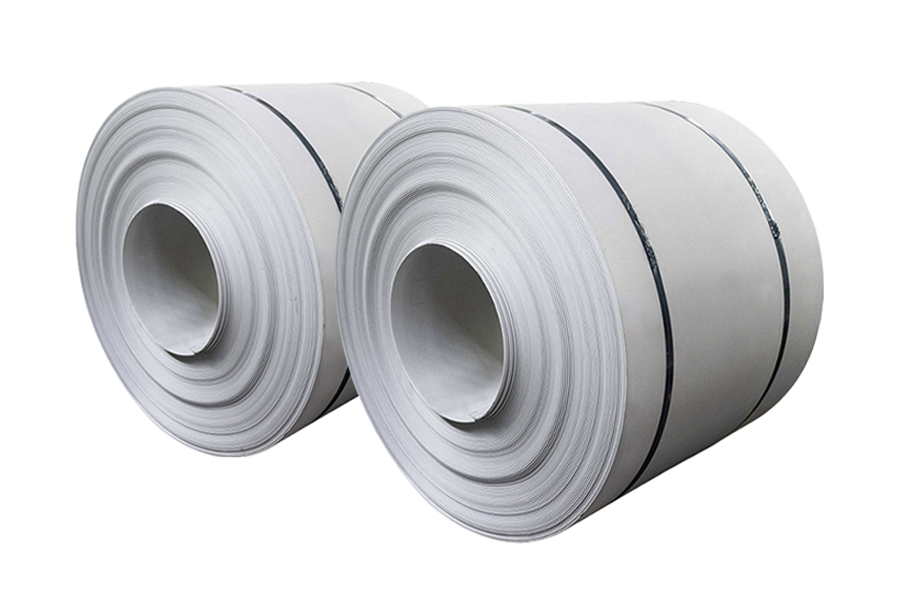
301 hot-rolled coil is produced by heating stainless steel slab to approximately 1100–1250°C and passing it through a series of rolling mill stands that progressively reduce thickness while maintaining the austenitic microstructure through the hot-working temperature range. The hot rolling process produces a coil with an oxide scale layer (mill scale) on the surface — a mixture of iron and chromium oxides formed by high-temperature oxidation during rolling and cooling.
Because mill scale is hard, brittle, and electrochemically active in ways that can initiate corrosion, hot-rolled coil intended for further processing is typically supplied in one of two surface conditions:
No. 1 Finish (Hot-Rolled, Annealed, and Descaled)
The standard delivery condition for hot-rolled stainless steel coil. After hot rolling and annealing, the scale is removed by a combination of mechanical shot blasting and chemical pickling in mixed nitric-hydrofluoric acid solutions. The resulting surface is dull gray, slightly rough with visible rolling marks and occasional minor surface irregularities, and fully passive — ready for cold rolling, forming, or fabrication into finished components. The No. 1 finish is not a decorative surface and is not used in visible applications without subsequent cold rolling and polishing operations.
Hot-Rolled Black (As-Rolled, Unprocessed)
Some procurement specifications call for hot-rolled coil with the mill scale intact — sometimes referred to as "black coil" — for applications where the coil will undergo controlled descaling as part of the customer's in-house processing line. Black coil is lower in delivered cost but requires the buyer to manage descaling, which adds process complexity and chemical handling requirements. It is less commonly specified than fully descaled No. 1 finish coil in most downstream manufacturing environments.
Corrosion Resistance: Where 301 Performs and Where It Faces Limitations
Grade 301's corrosion resistance is adequate for many industrial and commercial environments but is meaningfully inferior to 304 in aggressive conditions. The lower chromium and nickel content reduces the stability and protective capacity of the passive oxide film, making 301 more susceptible to pitting and crevice corrosion in chloride-containing environments — such as coastal atmospheres, marine service, or de-icing salt exposure — compared to 304 or 316.
A critical consideration specific to 301 is the effect of strain-induced martensite on corrosion resistance. The martensite phase formed during cold working has a different electrochemical potential from the austenite matrix, creating galvanic microstructure conditions that can accelerate localized corrosion at highly cold-worked zones in formed components. For applications in moderately corrosive environments where 301 is used in cold-worked tempers, surface finishing — including mechanical polishing, electropolishing, or passivation treatment per ASTM A967 — is recommended to maximize corrosion performance by optimizing the surface passive film.
In dry indoor environments, mildly humid atmospheres, food contact applications without aggressive acids or high chloride concentration, and architectural applications where periodic cleaning is maintained, 301 provides reliable corrosion resistance that is sufficient for years of service without surface degradation. The key is honest application assessment — specifying 301 where 304 or 316 is actually required, because of its lower cost, leads to premature corrosion failures that negate any procurement savings.
Key Industries and Applications That Specify 301 Hot-Rolled Coil
The unique combination of high work-hardenability, good base corrosion resistance, and attractive economics makes 301 hot-rolled coil the material of choice across several demanding industrial sectors where both strength and stainless performance are required simultaneously.
- Railway and Transportation Rolling Stock: Structural sections, side panels, roof panels, and underframe members for passenger rail cars and metro vehicles are among the most demanding applications for 301 hot-rolled coil. The material is cold-rolled and formed to half-hard or three-quarter-hard temper to provide structural sections with tensile strength exceeding 1000 MPa while maintaining the corrosion resistance and aesthetic quality required in passenger environments. Major rail vehicle manufacturers in Europe, China, and North America specify 301 as a primary structural stainless alloy alongside 304.
- Precision Springs and Elastic Components: Full-hard 301 strip cold-rolled from hot-rolled coil is the standard material for flat springs, snap rings, retaining clips, contact springs in electrical connectors, and constant-force spring assemblies. The combination of high yield strength, adequate fatigue resistance at moderate stress amplitudes, and corrosion resistance in indoor environments makes it economically superior to more expensive spring alloys in applications where peak stress levels do not exceed the material's fatigue limit.
- Automotive Components: Exhaust system brackets, hose clamps, seat frame reinforcements, and structural stampings in automotive body-in-white applications use 301 at various work-hardened tempers. The material's ability to be deep drawn in the annealed condition and then achieve high strength through subsequent cold work in areas of the formed part that undergo large strain during forming is a design strategy that allows strength and formability to be simultaneously exploited in complex automotive stampings.
- Architectural and Structural Cladding: Where structural panels, facade elements, and roofing systems require high strength-to-weight ratios in corrosion-resistant stainless steel, 301 in half-hard or three-quarter-hard temper offers a cost-effective solution. The ability to achieve structural panel stiffness in thinner gauge material reduces weight and installed cost compared to equivalent constructions in softer grades.
- Industrial Equipment and Enclosures: Control panel enclosures, instrument housings, machine guards, and process equipment covers in non-aggressive industrial environments use 301 for its combination of corrosion resistance, formability during fabrication, and strength in the finished component — properties that allow thinner gauge material to meet structural requirements without the cost premium of more highly alloyed grades.
Specification and Procurement Checklist for 301 Hot-Rolled Coil
Procuring 301 stainless steel hot-rolled coil requires specifying several interrelated parameters that collectively define the material's identity, condition, dimensions, and quality requirements. Incomplete specifications leave room for supplier interpretation that may result in material unsuitable for the intended application. The following checklist covers the essential specification elements for a complete and unambiguous purchase order:
- Material Standard and Grade: Specify the governing standard explicitly — ASTM A666 (USA), EN 10088-2 (Europe, grade 1.4310), JIS G4304 (Japan, SUS301), or GB/T 4237 (China, 12Cr17Ni7). Different standards have slightly different composition and property limits; confirming which standard governs the purchase prevents ambiguity in supplier compliance.
- Condition and Temper: Specify annealed and descaled (No. 1 finish) for coil intended for cold rolling or forming, or specify the required cold-worked temper (1/4H, 1/2H, 3/4H, FH) if procuring temper-rolled strip directly. Include both minimum and maximum mechanical property limits where both strength and formability must be controlled.
- Thickness and Width Tolerances: State the nominal thickness and width together with the applicable tolerance class per the governing standard. For precision cold-rolling feedstock, tighter-than-standard thickness tolerances (e.g., ±0.05mm on a 2.0mm nominal) should be specified explicitly and confirmed with the mill before order placement.
- Coil Weight and Inner/Outer Diameter: Specify minimum and maximum coil weight, mandrel (inner) diameter, and maximum outer diameter compatible with your uncoiling and handling equipment. Mismatched coil geometry causes handling problems and potential equipment damage during decoiling.
- Mill Test Certificate Requirements: Require a 3.1 mill test certificate per EN 10204 (or equivalent) confirming chemical analysis heat results, mechanical test results per heat and thickness range, and the applicable standard compliance declaration. For critical structural applications, specify that certificates must be traceable to the specific coil identification markings.